


Saving or investing: which is better for your money?
You’ve been putting money aside every month. At some point, though, a question pops up: am I doing this right? Should you be investing as well? And if so, how much should stay in savings, and how much should go into the markets?
We hear this a lot. The short answer is simple: you need both. But for different reasons. And in different proportions, depending on your life. In this article, we’ll give you a clear framework to decide what makes sense for you.
Saving vs investing calculator
Adjust the numbers below to see how much your money could grow, depending on whether you save or invest it.
Saving vs investing: what's the difference?
At first glance, both saving and investing are about growing your money. But they work very differently, and serve very different purposes.
Saving means putting money in a place where it's safe and accessible, typically a savings account. The upside is that your money is always there when you need it and the value doesn't fluctuate. The downside? The returns are low.
Let's put this in perspective: If you keep €10,000 in a savings account with a 0.6% interest rate for 10 years, you'll earn about €615 in interest. But with just 2% annual inflation, your €10,000 will only have the purchasing power of about €8,200 after those same 10 years. In other words, your money is slowly shrinking rather than growing.
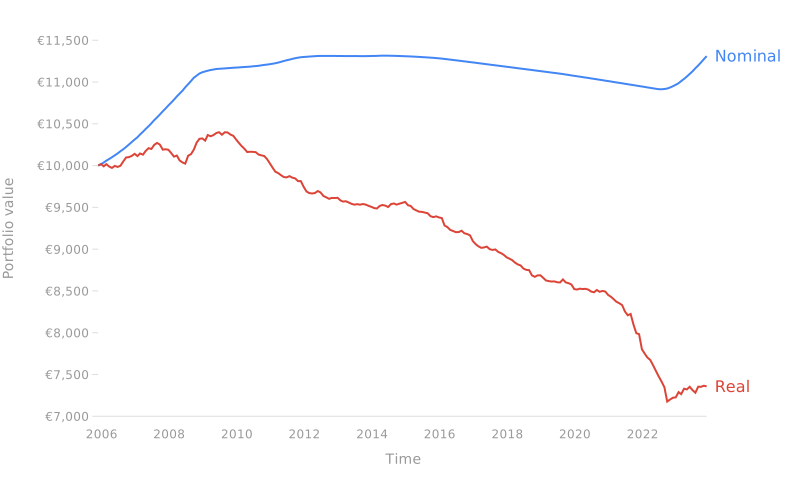
A savings account won't help you much with achieving your long-term goals. Instead, investing in the financial markets is a way to earn a higher return and meet your financial goals. For instance, a global stock ETF earned a 8.8% average annual return since 1988. Considering the average yearly inflation is around 2%, this earns a healthy return above inflation. The reason for the superior performance is that by investing in the financial markets, you earn a dividend on the growth of the world economy. An investment in the stock market fluctuates more than a savings account. But for that risk, you are rewarded with a much higher return on the long-term.
Why a savings account alone isn't enough
Here's the uncomfortable truth: if your entire financial plan is a savings account, you're almost certainly losing money, not in euros, but in purchasing power.
We can see this when comparing the historical performance of a savings account and global stocks. The average return of a savings account, as measured by the interest rate of the ECB, these last 20 years was around 1.0%. But it's been around 8.5% for global stocks as measured by the MSCI ACWI index.
Of all types of investments, we think that ETFs are the best way for most people to grow their wealth over the long term. They're cheap, diversified, and you can buy and sell them at any time. But managing your portfolio of ETFs yourself comes with challenges. That's why we built Curvo: to be the most accessible way for Belgians to start investing in a diversified portfolio that suits their goals.
The key difference: saving is about security and short-term access. Investing is about long-term growth. Neither one alone is the full picture.
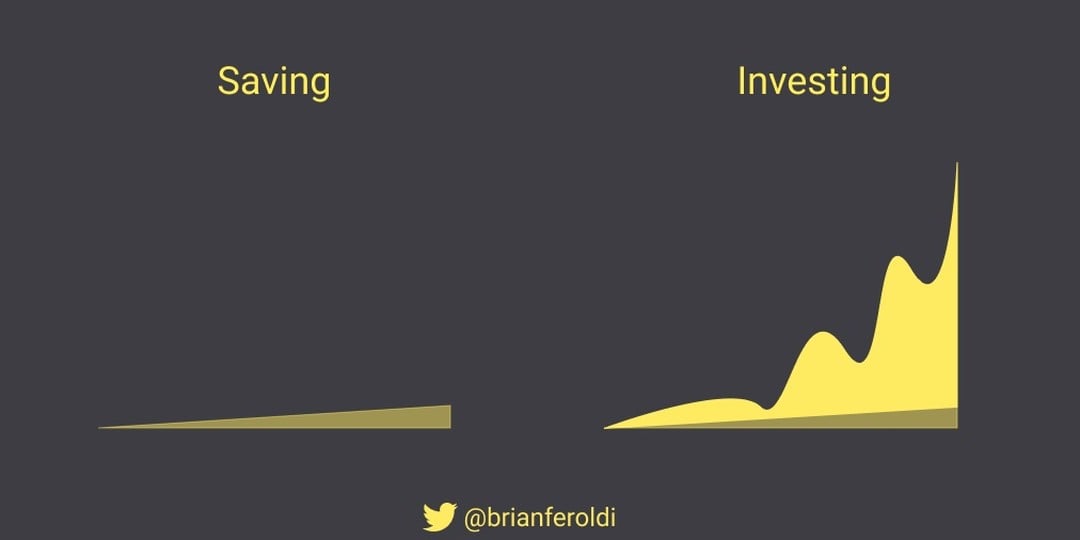
That said, the answer isn't to invest everything either. You need savings for a reason, and that reason is stability. The illustration below shows the difference between a savings account and investing. A savings account provides a predictable and stable return. But you don't earn much of a return. Investing is more of a roller coaster because the financial markets go up and down over time. But over the long term, you can be almost certain that you will earn a higher return.
Your money has two jobs
The easiest way to think about saving vs investing is to picture two separate buckets. They're not competing with each other, they're doing two completely different jobs. Here is what each one is for.
What saving is for
Your savings bucket is for money you might need soon or money you can't afford to risk. This includes:
- Your emergency fund: A safety net covering 3 to 6 months of living expenses, in case you lose your job, your car breaks down, or your boiler gives up in January. Curvo co-founder Yoran has six months of savings on a high-interest savings account.
- Short-term goals: Anything you're planning to spend within the next 2 to 3 years: a holiday, a new car, a wedding, or a house down payment. You can't afford to have these funds drop 20% in value right before you need them.
For this bucket, a high-interest savings account makes perfect sense. You want access, stability, and ideally the best rate you can find.
What investing is for
Your investment bucket is for money you won't need for at least 5 years, ideally longer. This is wealth you're building for the future: retirement, financial independence, or simply not having to worry about money in your 50s and 60s. Because you're not touching this money any time soon, short-term market fluctuations don't matter. The stock market goes up and down, but over a decade or more, it has consistently gone up. That's what makes long-term investing so powerful.
Think of it this way: keeping long-term savings in a savings account is like driving to a destination that's 500 km away at 30 km/h. You'll get there eventually, but you're leaving an enormous amount of time and return on the table.
Framework for finding balance
There's no single magic ratio that works for everyone. But there is a logical order of the way to get setup that makes sense for most people.
Build your emergency fund first. Before you think about investing a single euro, make sure you have 3 to 6 months of expenses sitting in a savings account. This is your financial foundation. Without it, any unexpected expense could force you to sell investments at the wrong moment.
Set aside money for short-term goals. Identify what you're saving for in the next 2 to 3 years and keep that money separate in a savings account. Don't invest it.
Invest the rest. Once your emergency fund is covered and your short-term goals are accounted for, every euro left over that you won't need for 5+ years should be working for you in the markets.
Say you earn €3,000/month and spend €2,200. You want 4 months of expenses as your emergency fund, so your target is €8,800. Once that's in place, your monthly €800 surplus might look like this: €150 toward a savings goal (say, a holiday next year), and €650 invested every month into a diversified index fund. That €650/month invested over 20 years could grow to around €380,000, without ever picking a single stock.
How much should you invest vs save?
There's a popular 50/30/20 rule: 50% of your income on needs, 30% on wants, 20% on savings and investments. It's a decent starting point, but it's a blunt tool and not really tailored to everyone. The right split for you depends on your life stage.
Lean more toward investing if:
- You're young, have a stable income, and no big purchases coming up in the next 2–3 years
- Your emergency fund is already solid
- You have a long time horizon (10+ years) before you need the money
Keep more in savings if:
- You're planning a big purchase within the next 2–3 years (house, car, etc.)
- Your income is irregular or your job security is uncertain
- You haven't built up a solid emergency fund yet
The most important thing is to start. Don't wait until you have the perfect amount before investing. Even €50 a month invested consistently for decades is vastly better than waiting.
Which savings account to use in Belgium
We regularly update our comparison of the best savings accounts in Belgium, so you can find the highest rate available without spending hours doing the research yourself:
Interest rate
Convenience
Fees
Taxes
Safety
| NIBC Opti rekening | 3.50% |
|---|---|
| Belfius Flow spaarrekening | 3.33% |
| Fintro Spaarrekening Boost | 3.25% |
| BNP Paribas Fortis Spaarrekening Boost | 3.25% |
| vdk bank Ritme | 3.17% |
| KBC Start2Save | 3.15% |
| Argenta Groeirekening | 3.15% |
| ING Tempo Sparen | 3.10% |
| Crelan GoSave | 3.00% |
| Banque CPH Dépôts Plus | 3.00% |
| MeDirect Essential | 2.20% |
| Santander Vision Plus | 2.00% |
| Keytrade Bank High Fidelity | 2.00% |
| NIBC Getrouwheidsrekening | 1.80% |
| Europabank Jongerenboekje | 1.75% |
| Banque CPH Dépôts 12 à 25 ans | 1.70% |
| MeDirect Fidelity | 1.70% |
| Bank Van Breda Depositorekening Fidelity | 1.70% |
The data was last updated on . Please verify the accuracy with the relevant banks before making your decision.
What to invest in as a Belgian just starting out
This is where many people overthink it. The good news: for most people, the answer is simple.
Index funds and ETFs are the go-to for long-term investors. Rather than trying to pick winning stocks, you invest in the entire market. A global stock ETF like one tracking the MSCI ACWI index gives you exposure to over 4,000 companies across 40 countries, in one single investment. This approach is called passive investing. You're not trying to beat the market, you're riding it. And historically, that's been more than good enough. It's cheaper, simpler, and for most investors, more effective than active stock picking.
As a Belgian investor, there are a few things worth knowing. When you buy and sell ETFs, you pay a stock exchange tax (TOB) of at least 0.12%. Dividends and interest income are taxed at 30% withholding tax, though accumulating ETFs (which reinvest dividends automatically) can be more tax-efficient. These details matter, but they shouldn't stop you from starting, the long-term returns of investing far outweigh these costs.
If you'd rather not deal with choosing ETFs, rebalancing your portfolio, and navigating Belgian tax rules yourself, that's exactly what Curvo takes care of for you. You answer a few questions about your goals and risk appetite, and Curvo manages a diversified portfolio of index funds on your behalf, so you can invest monthly without the complexity.
Common mistakes to avoid
A few pitfalls come up when people try to balance saving and investing and we've seen it first hand with our customers at Curvo:
- Investing money you'll need soon. If you're buying a house in 18 months, that down payment should be in a savings account, not in the stock market. Markets can drop 30% in a year, and you can't afford to be forced to sell at the wrong time.
- Hoarding cash just in case. Once your emergency fund is funded and your short-term goals are covered, excess cash sitting in a low-interest savings account is quietly losing value. Give it a job and get it working for you.
- Waiting to have enough to start investing. Time in the market beats timing the market. The best time to start was yesterday. The second best time is today, even with a small amount. Charlotte's €50 test began with an amount she was ready to lose.
- Trying to time the market. Nobody consistently predicts market movements, not even professional analysts or hedge funds. The simple, boring strategy of investing a fixed amount every month (regardless of whether the market is up or down) is one of the most effective approaches available.
- Leaving your savings in a low-interest account. Banks vary wildly in what they offer. A few minutes of comparison can meaningfully improve your savings rate. Check what you're currently earning and compare it to the best available accounts in Belgium.
Summary
Saving vs investing isn't a competition. It's not a question of one or the other. It's about giving every euro a purpose based on when you'll need it. Keep 3 to 6 months of expenses in a savings account as your safety net. Set money aside in savings for anything you'll need within the next 2 to 3 years. And invest everything else for the long term, consistently, in a diversified portfolio.
That's the balance. It's not complicated but it requires actually doing it. Start by calculating how much you need in your emergency fund. Then figure out what's left over, and put it to work. Future you will be glad you did. And if you want to get started with the investing side without the complexity, discover how Curvo works.