


Why simple investing is good investing
When we first tried to invest, we were overwhelmed by the sheer number of choices. Hundreds of funds, dozens of brokers, complex tax rules, and conflicting advice from every direction. The financial industry seemed designed to make investing feel impossible without expert help.
But here's what we've learned after years of researching and building Curvo: the simpler your investment strategy, the better your results. This isn't just our opinion, it's what the data consistently shows.
In this guide, we explain why simple investing beats complexity, and how you can put this into practice as a Belgian investor.
What is simple investing?
Simple investing means building a portfolio with a small number of broadly diversified index funds or ETFs, investing in them regularly, and holding them for the long term. That's it.
Instead of trying to pick the next Amazon stock, time the market, or chase the hot fund of the year, you buy the entire market. As John Bogle, the founder of Vanguard and pioneer of index investing, put it: rather than looking for the needle in the haystack, you buy the whole haystack. In practice, a simple portfolio might consist of just one or two globally diversified ETFs. A single fund like the SPDR MSCI ACWI IMI gives you exposure to over 9,000 companies across 47 countries. That's it, one fund, and you're invested in practically the entire world economy.
Historically, it works too. Between 1994 and today, it returned an average 7.8% per year. Of course, it had its ups and downs. 2008 was a bad year, and so was the 2000 dotcom-bubble. But over the long term, investing in stocks through diversified index funds or ETFs is one of the best investments you can make to beat inflation.
Compare this to the "complex" approach: picking individual stocks, investing in actively managed funds, trading based on news cycles, dabbling in options or CFDs, or constantly reshuffling your portfolio based on the latest market predictions. Complexity feels productive. As the late Jonathan Clements points out in his excellent book How to Think About Money, we believe the secret to investment success is hard work: diligently reading corporate annual reports or trading rapidly throughout the day. But as we'll see, it almost always leads to worse outcomes than sticking to a simple investment strategy.
Why simple investing outperforms complex strategies
Lower costs, higher returns
The most powerful argument for simplicity is cost. Active funds, the sort most Belgian banks sell you, charge fees that seem small but compound into enormous amounts over time.
Let's make this concrete with a Belgian example. KBC offers the "KBC Equity Fund World" (BE6213775529), an actively managed fund that tries to beat the global stock market. Its yearly fee is 1.72%, and there's a 3% entry fee on top. Compare that to the iShares MSCI ACWI ETF (IE00B6R52259), which tracks the same benchmark for just 0.20% per year and no entry fee.
| KBC Equity Fund World (active fund) | iShares MSCI ACWI (index ETF) | |
|---|---|---|
| Entry fee | 3.00% | 0% |
| Yearly fee | 1.72% | 0.20% |
That difference might seem trivial. But over decades, it's devastating. If you had invested €10,000 in both funds in 2005, the index fund would have grown to approximately €55,000 by the end of 2024 (an average return of 8.6% per year). The KBC active fund? Roughly €28,000 (4.9% per year). That's a difference of €27,000, more than your original investment, eaten up by fees and underperformance:
This isn't an exception. It's the rule.
Most active funds lose to the market
The European Securities and Markets Authority (ESMA), Europe's financial regulator, has studied the performance of active funds extensively. Their findings are damning: more than 75% of actively managed funds underperform their benchmark index over the long term.
What makes this even worse is that the group of funds that does outperform keeps changing. A fund that beats the market over five years is very unlikely to repeat that performance over the next five. So even if you could identify last decade's winners, it wouldn't help you pick tomorrow's.
This means that by choosing a simple index fund, you're automatically positioned in the top 25% of investors. Not by being clever, but by avoiding the drag of high fees and poor stock-picking decisions.
Fewer decisions means fewer mistakes
Every investment decision you make is an opportunity to get it wrong. And the research from behavioural finance is clear: we are spectacularly bad at making rational financial decisions.
We sell when markets drop because panic takes over. We buy when markets are euphoric because we don't want to miss out. We hold on to losing stocks because admitting a mistake feels painful. We trade too often because it feels like we're "doing something."
A simple investment strategy removes nearly all of these decision points. You choose your portfolio once. You invest regularly, ideally through an automated monthly plan. And you don't sell until you've reached your goal, regardless of what the markets do this week, this month, or even this year. Academic research confirms this. In a landmark study after the dot com bubble, economists Brad Barber and Terrance Odean analysed 66,000 investors and found that those who traded the most earned the lowest returns. Trading, quite literally, was hazardous to their wealth.
Take emotions out of the equation. With Curvo, you set up automatic monthly investments starting from €50. No temptation to time the market. Learn more →
Diversification is built-in
When you invest in a global index fund, you're automatically diversified across thousands of companies, dozens of countries, and every major industry. You don't need to worry about whether tech is overvalued, whether European banks are risky, or whether emerging markets will outperform this year. You own all of it.
This matters because the returns of the stock market are driven by a surprisingly small number of companies. Research has shown that many individual stocks actually underperform government bonds over their lifetime. Curvo co-founder Thomas has lived the “single-stock risk” lesson. He thought he’d spotted an obvious trend: Fitbits would be a popular Christmas gift, so he bought the stock on November 4, 2016. But the market had other plans. Just two months later, by January 5, 2017, Fitbit had fallen about 40%. That drop turned optimism into a wake-up call: one stock can be unforgiving, even when the story sounds right. It’s a tiny minority of exceptional performers, companies like Apple, ASML, or Novo Nordisk, that drive the market’s returns.
If you're picking stocks yourself, the odds of owning enough of these winners are slim. But with a global index fund, you own all of them by default. You don't need to find the needle. You already have the haystack.
Better for your mental health
This is an underappreciated benefit of simple investing. Active investors live in a constant state of anxiety: monitoring stock prices, watching financial news, second-guessing their decisions, feeling regret about stocks they didn't buy or sold too early. Index investors who've adopted a simple, buy-and-hold strategy don't have these worries. Short-term market fluctuations become irrelevant when your time horizon is 10, 20, or 30 years. You can check your portfolio once a month, or even less frequently, and spend your mental energy on things that actually matter to you.
At Curvo, we call this the hammock investment approach. Our co-founder Yoran is one of the authors of the book which shares the same name. Set up your investments properly, automate your monthly contributions, and then go lie in a hammock. Your money is working for you, and you don't need to watch it every day.
What does a simple portfolio look like?
A simple portfolio doesn't need to be complicated. Here are three examples that cover most investors' needs.
- 100% stocks (for long time horizons of 10+ years): A mix of stocks that invest in both developed markets (US, Europe, etc) and emerging markets (Taiwan, Brazil, etc). An example is the Curvo Growth portfolio, with an 80% allocation to stocks from developed markets and 20% to emerging markets. Or, if you want to manage your own portfolio of ETFs through a broker, you could opt for an ETF tracking a world index.
- 50% stocks, 50% bonds (for lower risk tolerance): Adding bonds reduces the ups and downs of your portfolio. This might be better suited if you're closer to needing your money, or if market swings genuinely keep you up at night.
The key insight: you don't need 15 different funds. Two or three is plenty. More holdings don't mean more diversification, they just mean more complexity, more rebalancing, and more chances to make mistakes.
Simple investing in Belgium: what you need to know
How to get started
There are essentially three ways to start simple investing in Belgium:
| Broker (DIY) | Curvo | Financial advisor | |
|---|---|---|---|
| Portfolio built for you | ❌ | ✅ | ✅ |
| Automated monthly investing | ❌ | ✅ | ❌ |
| Lowest ongoing costs | ✅ | ❌ | ❌ |
| No learning curve | ❌ | ✅ | ✅ |
| Tax optimised | ❌ | ✅ | ✅ |
| Best for beginners | ❌ | ✅ | ✅ |
Option 1: Do it yourself through a broker
You open an account with a broker like Bolero, DEGIRO, or Trade Republic, and buy ETFs yourself. This gives you full control and is the cheapest option in terms of ongoing fees. But you're responsible for everything: choosing the right funds, executing orders every month, handling taxes, and maintaining discipline over years and decades. We've written a guide to the best brokers for Belgians if you want to go this route.
Option 2: Everything taken care of through an app like Curvo
We built Curvo precisely because we experienced the difficulties of the DIY approach firsthand. With Curvo, you answer a few questions about your goals and risk tolerance, and we build a globally diversified, tax-optimised, sustainable portfolio for you. Investing is automated monthly from €50, and you never need to worry about rebalancing, tax optimisation, or executing trades. It's simple investing made even simpler.
Sam tested both approaches at once, running a self-managed DEGIRO portfolio next to Curvo for nearly five years. The returns nearly tied. Read Sam's five-year comparison.
Option 3: Work with a financial advisor
A good advisor can help you with more than just investing. They can advise on tax planning, estate planning, and overall financial strategy. They charge a relatively high fee, so this option makes most sense if you have a larger sum to invest.
However, make sure that you choose an independent advisor. In Belgium especially, most advisors are tied to a bank, so they only sell the bank's products. You get the financial advice only if you also invest in the bank's products. And the investment products sold by most banks are expensive and often of subpar quality, namely the expensive active funds that employ overly complex strategies.
The sad thing is that there are very few independent financial advisors in Belgium and they are limited in the services they can offer. The reason is a regulatory framework that is too prohibitive. The FSMA, the Belgian financial regulator, doesn't have a license for independent financial advisors. So even if someone wants to offer independent financial advice, there is no way they can do so legally.
This is a severe problem for Belgian savers. Millions could benefit from access to affordable, independent financial advice. But we don't see it being resolved anytime soon. The situation is great for the banks, because they are essentially the only ones able to offer financial advice, and they can tie the advice to the sale of their expensive funds. We think the problem simply doesn't get talked about enough. Other regulators are seeing the problem though and are trying to address it, like the FCA in the UK. We hope the FSMA in Belgium will come to a similar realisation and improve the situation for Belgians.
Tax considerations
Belgium's tax landscape for investors has recently changed with the introduction of a capital gains tax. The first €10,000 in gains is exempt, and gains above that are taxed at 10%.
A few practical tips to keep things simple:
Choose accumulating ETFs. These reinvest dividends automatically rather than paying them out to you. Since Belgium taxes dividends at 30%, accumulating funds save you money and administrative hassle. One less thing to worry about.
Be aware of the transaction tax (TOB). Every time you buy or sell an ETF in Belgium, you owe a transaction tax. The rate varies between 0.12% and 1.32% depending on the fund's characteristics. Choosing the right fund type can meaningfully reduce this cost.
Trade in euro. Investing in funds listed in currencies other than the euro adds an unnecessary layer of cost and complexity through currency conversion.
Belgian investment taxes are complex: transaction tax rates, dividend withholding, accumulating vs distributing funds. Curvo handles all of this automatically so you can focus on investing. See how it works →
The traps of complex investing
If simple investing is so effective, why does the financial industry push complexity? Because complexity is profitable, for them but not necessarily for you.
Banks earn more from complex products
Entry fees, management fees, performance fees, custody fees, the more products you hold and the more often you trade, the more your bank earns. A customer who buys one index fund and holds it for 20 years is not a good client for a bank. However, a customer who trades actively, switches between funds, and buys structured products? That's a goldmine.
Exotic products benefit the seller
Structured notes, turbo warrants, CFDs, binary options, these products are engineered to be profitable for the institution that creates them. The complexity makes it nearly impossible for regular investors to understand the true costs and risks. If you can't explain your investment in one sentence, it's probably too complex.
Information overload leads to paralysis
The financial news cycle is designed to make you feel like you should be doing something. Markets are crashing, should you sell? A new sector is booming, should you buy? A guru is predicting a recession, should you move to cash? For the simple investor, the answer to all of these is the same: stay the course. But it takes conviction to ignore the noise, and that conviction comes from understanding why simplicity works.
How Curvo makes simple investing effortless
We built Curvo because we believe everyone deserves access to a sound investment strategy, not just those with the time and expertise to manage their own portfolio.
Our co-founder, Yoran, spent countless hours researching how to build an optimal investment portfolio. He read books, scoured the web, and got lost in Reddit threads. Through that process, he realised something: the reason his friends weren't investing wasn't a lack of interest. It was that the whole process was just too complicated. And the financial industry had no incentive to make it simpler. Here's what we do differently:
A portfolio built for you. When you create an account, we ask about your goals, time horizon, and appetite for risk. Based on your answers, we match you with the portfolio that fits you best. Each portfolio is globally diversified across more than 7,500 companies.
Sustainability at the core. All our portfolios exclude companies involved in non-renewable energy, weapons, tobacco, and other industries we consider destructive. You can grow your wealth without compromising your values.
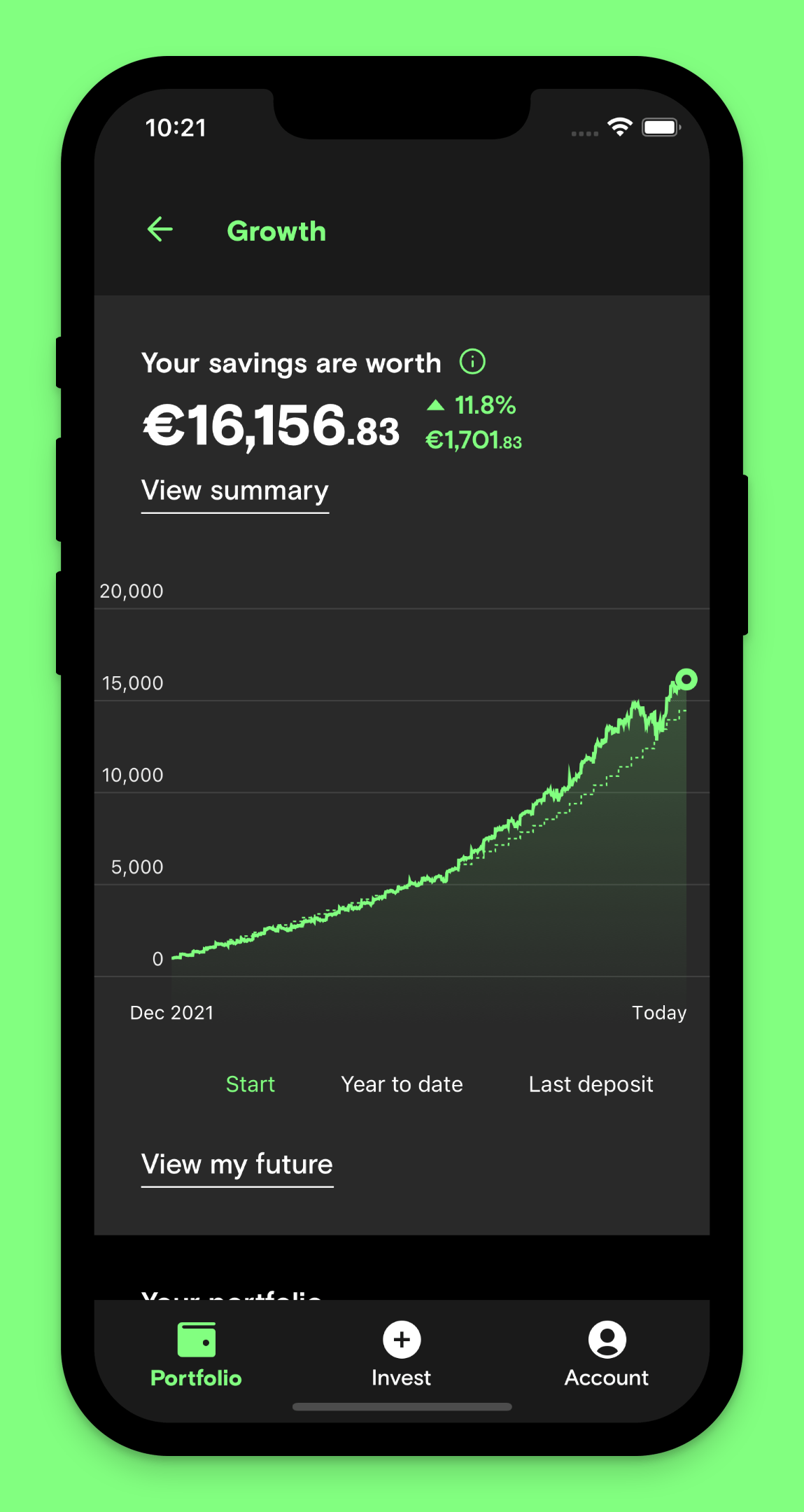
Automated monthly investing. Set up a monthly plan starting from €50, and your money is automatically invested at the beginning of each month. No manual orders, no forgetting, no excuses. Dollar-cost averaging on autopilot.
No jargon, no learning curve. You don't need to understand what a UCITS is, what an ISIN code means, or how rebalancing works. We handle all of that. You just invest and grow your wealth.
Summary
Simple investing isn't a compromise. It's not "good enough" for people who don't know any better. It's the strategy that beats the majority of professional fund managers, minimises costs, reduces emotional mistakes, and has been proven to build wealth over decades.
The financial industry wants you to believe that investing is complicated, because complexity is how they make money. But the evidence is overwhelming: the less you pay, the less you trade, and the more you diversify, the better your results.
You don't need to be a financial expert. You don't need to watch the markets every day. You don't need 20 different funds. You just need a simple plan and the discipline to stick with it. And if you'd like someone to handle the details for you, that's exactly what we built Curvo to do.