


S&P 500 index explained for Belgians
You've heard people talk about the S&P 500. Maybe a colleague mentioned it, or you saw it in a headline about the stock market. It sounds important, but what actually is it? And more practically, how do you invest in it as a Belgian?
The good news is that the S&P 500 is simpler than it sounds. It's just a collection of 500 large American companies. The tricky part comes after: choosing the right ETF, understanding Belgian taxes, picking a broker and managing everything yourself. Or deciding if there's an easier way that still gets you the diversification you're after.
In this guide, we'll explain what the S&P 500 actually is, why it's popular with long-term investors and how you can invest in it from Belgium.
What is the S&P 500 index?
An index groups a bunch of stocks together. Stocks are simply shares of companies. These groups exist to help you understand how a stock market, or a specific part of it, is doing.
You've probably heard of the S&P 500. It includes the 500 largest American companies and gives a good picture of how the U.S. stock market is performing. Belgium has its own index too, the BEL 20, which tracks 20 major Belgian companies.
As the full name suggests, the S&P 500 focuses only on U.S. companies. They come from a wide mix of industries like tech, finance, healthcare and consumer goods. Because it includes so many large firms, the S&P 500 represents around 80% of the entire American stock market. So by following it, you get a broad sense of how the U.S. economy is doing.
The S&P 500 is weighted by market cap. This means bigger companies have a larger impact on the index. So giants like Apple, Microsoft, Amazon and Alphabet (Google) sit at the top because of their huge size. When they move, the index moves with them.
Why the S&P 500 is a good investment
One of the big reasons many investors like the S&P 500 is diversification. By owning the S&P 500, you're not betting on a single company. You're investing in 500 of them at the same time. This spreads your money across many sectors and businesses, which lowers the risk that one company's bad day ruins your whole portfolio.
You also avoid putting too much faith in one industry. Instead, you get exposure to a wide slice of the U.S. economy. Tech, banks, healthcare, supermarkets, it's all in there.
Another reason the S&P 500 is popular is its long-term track record. The U.S. stock market has grown over time, even if the ride was bumpy in the short term. By staying invested, you benefit from this long-term growth. Since 1992, the S&P 500 has returned around 11.0% per year on average. It's a strong performance and it has beaten many other markets over the past decades.
Another reason many people gravitate toward the S&P 500 is how simple and low-cost it is to invest in. Instead of trying to pick the "right" stocks, and stressing about whether you're missing winners or holding on to losers, you can just buy the entire basket of top U.S. companies in one go.
Index funds and ETFs that track the S&P 500 are also very cheap to run, so their fees are tiny. Some cost as little as 0.03% per year. Compared to many traditional active funds, which often charge more than 2%, the difference is huge. Lower fees mean more of your money stays invested and keeps compounding.
And because you're buying the market as a whole, you don't need to monitor charts or trade all the time. Passive investing takes much less effort yet still captures the long-term growth of the market. In fact, the data is clear: over long periods, passive strategies tend to outperform investors who try to beat the market.
At Curvo, we strongly believe that index investing, like through the S&P 500, is the best way for most people to grow their long-term wealth. Through our app, you invest in a diversified portfolio of index that suits your goals. Each portfolio consists of over 7,500 companies.
How to invest in the S&P 500
You can't invest directly in an index. There's no button that lets you buy "the S&P 500". Instead, you invest through a fund that tracks it. Most people do this through an ETF, which is a fund traded on a stock exchange that tries to follow the performance of an index like the S&P 500 as closely as possible.
In Belgium, it's best to buy ETFs that are listed on European exchanges such as Euronext Amsterdam or Xetra. These ETFs follow EU rules and tend to be more tax-efficient for Europeans. To access these exchanges, you need a broker. A broker is an app or online platform that lets you buy and sell ETFs and holds them for you.
We have plenty of brokers to choose from. Each one has its own fees and quirks. Going through a broker gives you the most freedom because you can pick from thousands of ETFs, including several that track the S&P 500. But with that freedom comes work.
You have to choose the right ETF. You need to understand the taxes that apply in Belgium, like the transaction tax or the capital gains tax. You also have to choose the broker that fits your needs, set up your own portfolio and manage it over time. If you plan to invest every month, you'll need to remember to make the trades yourself. And you're responsible for keeping your portfolio balanced and aligned with your goals.
At Curvo we take a different approach. We handle all the complexities of good investing for you, so you don't have to worry. Just start your investment plan and spend your free time on the things that matter most to you.
The best S&P 500 ETFs
To invest in the S&P 500, you need to choose an ETF that tracks the index. But not all S&P 500 ETFs are the same. They differ in fees, how they handle dividends, where they're based and even which currency they trade in. As a Belgian investor, a few criteria matter more than others. Here's what to look out for.
ETF checklist
Distribution of dividends
ETFs either accumulate dividends or pay them out. Accumulating ETFs tend to be better for Belgians because paid-out dividends are taxed at 30 percent. An accumulating S&P 500 ETF reinvests the dividends automatically, which helps you avoid this tax and keeps more of your money invested.
Domicile
Many of the best ETFs for Europeans are domiciled in Ireland or Luxembourg. These countries have favourable tax treaties with the United States, which reduces withholding taxes on dividends inside the fund. Choosing an Irish or Luxembourg-domiciled S&P 500 ETF is usually the most tax-efficient option for Belgians.
Currency
Some S&P 500 ETFs trade in dollars. As a Belgian investor, this means your broker will convert your euros to dollars and charge you a fee each time. It's simpler and cheaper to buy an S&P 500 ETF listed in euros on a European stock exchange.
Size of the fund
A larger fund is generally safer. If an ETF manages billions rather than a few million, it's less likely to shut down. Bigger funds are also easier to buy and sell because there are more people trading them.
Replication method
S&P 500 ETFs either physically buy the stocks in the index or use derivatives to mimic performance. Physical replication is usually preferred. The fund owns the shares directly, which is easier to understand and avoids extra counterparty risks.
Cost (TER)
Every ETF charges a yearly fee, called the Total Expense Ratio. Lower fees mean more of your return stays in your pocket. Fortunately, S&P 500 ETFs are some of the cheapest in the world.
Exchange listings and broker fees
Not every ETF is available at the same cost through every broker. Some exchanges have higher trading fees. Ideally, pick an ETF listed on a major European exchange like Euronext or Xetra, where most brokers offer lower costs.
Sustainability
There are sustainable versions of the S&P 500 that exclude certain companies based on ESG criteria. They follow the same idea but adjust the holdings slightly. Just keep in mind that performance may differ a bit from the standard index.
Best S&P 500 ETFs
Based on the above, we suggest the following S&P 500 ETFs:
| ETF | Ticker | ISIN | TER | Size (assets) | Sustainable? |
|---|---|---|---|---|---|
| iShares Core S&P 500 | CSPX | IE00B5BMR087 | 0.07% | ~€116 billion | ❌ No |
| SPDR S&P 500 | SPYL | IE000XZSV718 | 0.03% | ~€11.7 billion | ❌ No |
| iShares S&P 500 ESG | ESPX | IE000R9FA4A0 | 0.07% | ~€395 million | ✅ Yes |
iShares Core S&P 500 (CSPX)
CSPX is the biggest S&P 500 ETF available in Europe, with over €100 billion in assets. It's Ireland-domiciled, accumulating and charges a low 0.07% yearly fee. The fund physically holds all 500 companies in the index. Because of its size, stability and long track record, it's a very solid choice for long-term investors.
SPDR S&P 500 (SPYL)
State Street's SPDR version is the cheapest S&P 500 ETF on the European market, with an expense ratio of just 0.03%. Like CSPX, it's Ireland-domiciled, accumulating and physically replicates the index. It's still smaller than CSPX, but it has been growing quickly thanks to its very low fees. If keeping costs as low as possible is your priority, this ETF is hard to beat.
iShares S&P 500 ESG (ESPX)
This ETF tracks a sustainable version of the S&P 500. It removes companies involved in coal, tobacco, weapons and other controversial areas. The result is an index of roughly 300 companies that meet certain ESG criteria. It's accumulating, has a 0.07% TER and trades in euros on Xetra. One thing to note is that it's still relatively small at around €395 million in comparison to the others but it shouldn't affect how easily you can buy and sell it with some brokers. But if sustainability is important to you, it's a good way to invest in the S&P 500.
You'll find more details in our full list of the best S&P 500 ETFs for Belgians, where we compare these options side by side.
Once you've picked the ETF that fits you, the process is simple. Open an account with your broker, search for the ETF's ticker or ISIN and place your buy order.
Downsides of investing in the S&P 500
The S&P 500 is a good index to invest in. But it has downsides you should be aware of.
It invests only in the US
The S&P 500 only represents about 40% of the global stock market. By investing only in this index, you miss out on companies in the rest of the world. Countries like China, India or Brazil may drive a large part of global growth in the coming decades.
It's also worth remembering that the US has been the star performer for the past 50 years. That doesn't mean it will keep outperforming forever. No country leads forever, and relying heavily on one single market increases the risk of disappointment. Even if the US is dominant today, basing your whole portfolio on it is still a bet.
It consists only of the largest companies
The S&P 500 includes only the biggest American companies. But smaller and mid-sized companies can generate strong returns too. Just like you benefit from spreading your money across multiple countries, you also benefit from spreading across different company sizes. A broader index like the MSCI World includes more than just the giants, which gives you a more balanced exposure.
The index is volatile
The S&P 500 is made up entirely of stocks, so it can fluctuate a lot. Sharp ups and downs are normal, but they're not comfortable for everyone. Depending on your goals and risk tolerance, a portfolio made only of S&P 500 stocks might feel too intense.
This is where diversification helps again. Bonds, for example, can stabilise your portfolio and make it easier to stay invested. The goal is to build something that lets you sleep well at night, not something that keeps you glued to the charts.
Straightforward index investing with Curvo
At Curvo, we believe index investing is one of the best ways for Belgians to grow their wealth over the long term. It's why we built Curvo in the first place, to make index investing easy and accessible for everyone, even if you've never invested before.
Buying an S&P 500 ETF through a broker is a good strategy. But it also comes with challenges around taxes, diversification, choosing the right ETF and handling the admin yourself. Curvo offers a different route. We handle the complexity of investing for you. And for many people, Curvo's Growth portfolio is an even better alternative to investing only in the S&P 500 because it's more diversified, simpler to manage and built for the long term.
Let's look at what Curvo does for you.
Diversify beyond the S&P 500
The indexes the Curvo portfolios are globally diversified. They include smaller companies too. As a consequence, the portfolio invests in over 7,500 companies spread across 40 countries, compared to the 500 companies in an S&P 500 ETF. This allows you to broaden your investments and not make a single bet on one country or company size.
All your money is invested
When you invest through a broker, you often have to buy whole ETF shares. So if an S&P 500 ETF costs €400 and you want to invest €150 a month, you can't buy a fraction of a share. You need to wait until you've saved enough. Even with lower-priced ETFs, you usually end up with a few euros left sitting as cash. With Curvo, everything is fractional. Every euro gets invested, even if you only put in €50. Nothing sits idle. It also makes it easy to stick to a monthly investing habit without having to calculate anything yourself.
Automated monthly investing
Curvo lets you automate your investing. Through the app, you set up a direct debit and every month your money is invested for you. This keeps your investing habit simple and consistent. Regular investing also helps you avoid the temptation to time the market. You invest every month, no matter what the headlines say. Over time, this smooths the price you pay and reduces stress.
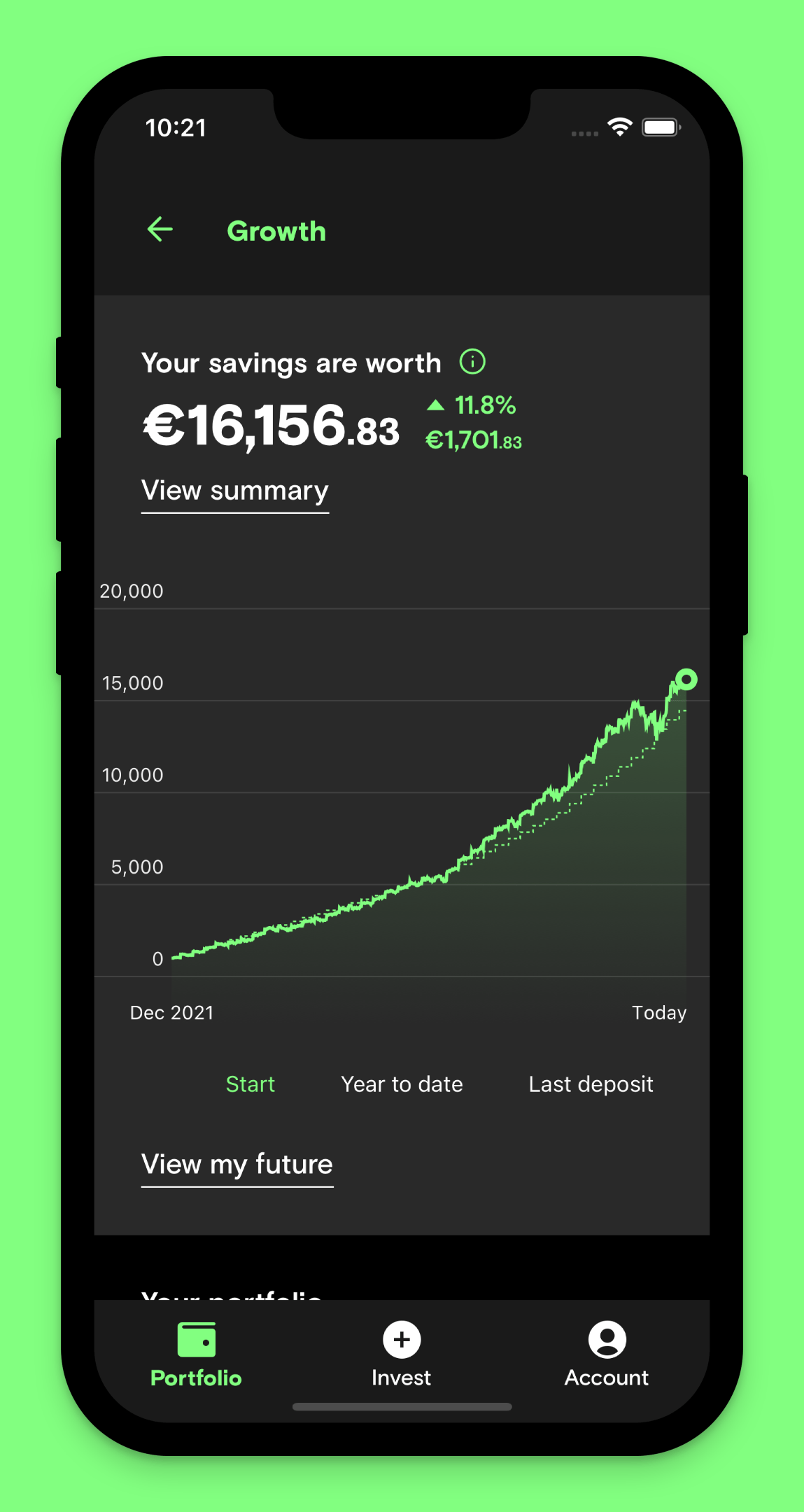
Portfolio tailored to you
Not everyone should invest the same way. A young investor saving for retirement might tolerate more risk, while someone saving for a house deposit may prefer more stability.
When you sign up to Curvo, we ask a few questions about your goals and how you feel about risk. Based on your answers, we match you with a portfolio that suits you. This is more targeted than putting all your savings in a single S&P 500 ETF, which may or may not fit your needs.
Invest sustainably
We take into account ethical views, by excluding companies involved in non-renewable energy, vice products, weapons and businesses that violate environmental or human rights standards. This means you can invest while knowing your money avoids the worst offenders, something the standard S&P 500 does not offer.
Buying ETFs on your own can be cheaper
It's true that managing your own ETFs through a broker can be cheaper. Most S&P 500 ETFs have tiny fees, and some brokers offer low-cost trading. Curvo charges an all-in management fee starting at 0.6% per year, which covers everything we do for you.
But cost isn't the only factor. Curvo handles the execution of trades, the tax considerations, rebalancing your portfolio and is there to help you along the way. Many investors find that paying for convenience, simplicity and peace of mind is worth it, especially if it helps them stay invested for the long term.
Conclusion
The S&P 500 has proven itself as a solid foundation for long-term investing. It gives you exposure to 500 of America's largest companies, with returns averaging around 10% per year over decades. But remember that it only covers one country and only the biggest firms. For many investors, a more globally diversified approach makes sense.
You have options. If you enjoy being hands-on, pick an ETF like CSPX or SPYL through a broker. You'll keep costs low and maintain full control. If you'd rather avoid the admin work and tax complexities, Curvo offers a simpler path with broader diversification built in. Either way, the most important decision is to start investing and stay consistent. Time in the market beats timing the market, no matter which route you choose.