


Taxation of Belgian pension saving: what you should know
Most Belgians know about the tax credit on pension saving. Fewer know about the 8% tax at age 60. Even fewer realise that early withdrawal costs you 33%. The Belgian pension saving scheme is built on tax incentives, but those incentives come with rules, limits, and a final bill.
Here's the complete breakdown of how taxation works on Belgian pension saving, from the credit you get today to the levy you pay at retirement.
The gist of it
- Two tax credit tiers: 30% if you contribute up to €1,050, 25% if you contribute €1,051–€1,350 (the 2025 ceiling).
- Final 8% tax at 60: a one-time levy, automatically withheld.
- Withdraw earlier and you face a 33% penalty.
- No transaction tax (TOB) on contributions (unlike buying ETFs or stocks).
- The 10% capital gains tax does not apply to Belgian pension saving.
What is the Belgian pension saving system?
Belgian pension saving ("pensioensparen" in Dutch or "épargne-pension" in French) is Belgium's third pillar of retirement savings. It's designed to encourage individuals to set money aside for their retirement on top of the state pension (pillar 1) and any occupational pension provided by an employer (pillar 2).
You open a pension saving account through a bank or insurer, and contribute up to a legally defined limit each year. In return, the Belgian state gives you a tax credit, essentially reimbursing part of what you've saved. Over time, those yearly contributions and tax benefits compound to form a meaningful sum at retirement.
There are two main types of pension saving products:
- Pension saving fund: Your contributions are invested in a mix of stocks and bonds. As they are linked directly to financial markets, returns fluctuate over time.
- Insurance-based pension saving: Offered by insurers as branch 21 (with a guaranteed return) or branch 23 (market-linked). They come with a life insurance, which can be both an advantage, but also a downside of branch 23 funds compared to pension saving funds.
The main incentive of the pension saving scheme is the tax credit. But you should know that it comes with rules on maximum contributions, early withdrawals, and end taxation.
Curious about which pension saving funds are on the market? Find out about our list.
How the tax credit works
Each year, you decide how much to contribute, either as a single payment or through monthly deposits, up to the legal maximum. For 2025, the cap is €1,350. Your tax reduction depends on how much you save:
- 30% if you contribute up to €1,050
- 25% if you contribute between €1,051 and €1,350
For example, if you save the full €1,350, you'll get €337.50 back through your tax return. Your provider will send you form 281.60, which you simply include in your annual tax declaration.
The thresholds are indexed over time, so they typically increase each year.
The end tax at age 60 (and why it matters)
This pension saving isn't "free money", as your banker may say. When you turn 60, the tax authorities apply a final 8% tax, which your provider automatically withholds. The exact calculation depends on your product type (fund, branch 21 or 23 insurance), but the result is the same: 8% at 60.
If you withdraw your savings before 60, you'll face a penalty of around 33%, which largely cancels out the earlier tax advantage.
Did you start saving after 55? Then the 8% tax is applied only after a minimum of 10 years, so you'll be taxed later than age 60. You can also keep contributing between 60 and 65 and still receive the annual tax reduction, without paying another final tax.
What taxes don't apply to pension saving
One of the perks of Belgian pension saving is that it's exempt from a few taxes that apply to regular investments:
- Transaction tax (TOB): You don't pay TOB on your contributions. By contrast, buying ETFs or individual stocks through a broker usually costs between 0.12% and 1.32% per trade.
- Capital gains tax : The 10% tax on most financial assets like stocks, ETFs, bonds, and crypto, doesn't apply to Belgian pension saving.
Capital gains tax calculator
Calculating your capital gains tax is tricky. That's why we built a tool that does it for you. It analyses your broker transactions and tells you exactly how much tax you owe, so you know what to declare.
Fees and product types matter
Not all pension saving products are the same. You can choose between:
- Branch 21 insurance: Offers a guaranteed return, but usually comes with lower growth and entry fees.
- Branch 23 insurance: Invests in financial markets, so returns fluctuate more, and you pay extra costs for the insurance wrapper.
- Pension saving fund: Doesn't include life insurance. It's usually cheaper than branch 23, but still comes with ongoing management fees.
Fees and restrictions vary a lot between providers, and over the years, these costs add up. For example, KBC's pension saving offering shows how you might face entry fees on branch 21 products, while fund-based options carry ongoing costs instead.
Pension saving is a good start, but rarely enough
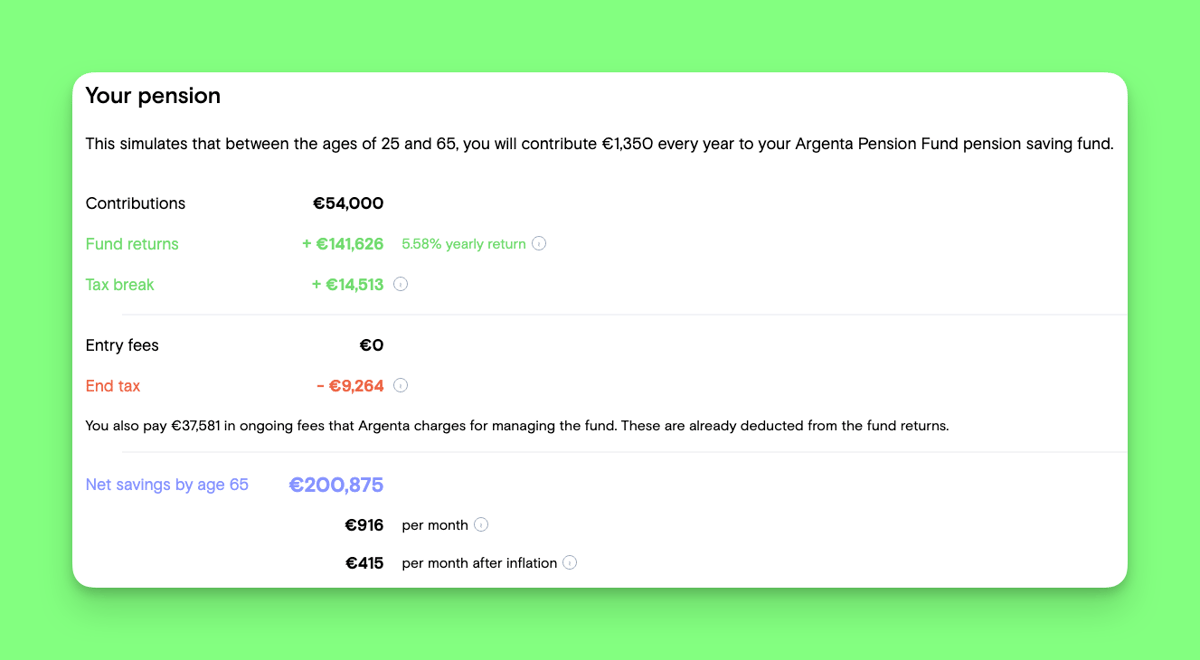
Because of the annual contribution limit, pension saving alone usually isn't enough to fund your retirement. Even when contributing the maximum each year, numbers show that the nest egg you build isn't enough to sustain a full retirement. For example, a 25-year old contributing €1,350 each year in one of the best funds (Argenta's Pension Fund) will result in only about a €400 monthly income after inflation. That's a nice extra, but hardly enough to live on.
Think of pension saving as your foundation. Once you've maxed it out, consider investing your extra savings in a diversified ETF portfolio to truly build long-term wealth.
Try our pension saving simulator to find out how much extra pension you can earn through pension saving.
ETF investing to grow your wealth
ETF investing gives you full flexibility. You can invest as much as you want, withdraw at any time, and build a portfolio that matches your goals. But there's no tax credit, and you do pay certain taxes:
- Transaction tax (0.12% to 1.32% per trade)
- Dividend tax (30% on distributing ETFs)
- 10% capital gains tax
Yet it works. Pension saving funds face strict rules that limit how much they can invest in equities and where, forcing them to focus on Europe and small companies. In contrast, global equity ETFs can invest 100% in stocks worldwide, giving them access to higher returns from markets like the US. ETF investing has proven to be one of the most effective ways to build wealth over time.
By owning small pieces of thousands of companies across the world, you benefit directly from global economic growth. Historically, broad stock market indices like the MSCI World or S&P 500 have delivered average annual returns of around 9% over the long run.
Because ETFs are low-cost, diversified, and easy to invest in regularly, they let your money compound quietly in the background, turning consistent monthly savings into significant wealth over the decades.
Curvo: grow your wealth hassle-free
At Curvo we believe building your financial future shouldn't be complicated. You don't need to worry about picking your ETFs, understanding taxes, paying high fees or navigating confusing rules. With our app you can invest in low-cost, diversified portfolios of index funds in just a few taps, leaving the heavy lifting to us (index funds are like ETFs, but slightly more tax-optimised in Belgium).
With Curvo, everything is set up for you: a globally diversified portfolio, automatic monthly investing, and no need to worry about rebalancing or paperwork. You invest in the world's best companies, while we handle the details.
If you're looking for a simple way to complement or move beyond your traditional pension savings, Curvo gives you an effortless path to long-term growth. No suits, no jargon, just clear investing for everyday people.
Learn how Curvo works.

Conclusion
The tax benefits of Belgian pension saving are real, but they come with limitations. You're capped at €1,350 per year, your money is locked until 60, and even with maximum contributions, the retirement income you build is modest at best.
That's why pension saving works best as part of a broader strategy. Think of it as your guaranteed foundation, then build on top of it with flexible, globally diversified investments. This combination gives you both the tax advantages and the growth potential you need for a comfortable retirement.
Fortunately, you don't need to be a financial expert to make this work. Tools like Curvo make it easy to invest regularly in diversified portfolios without the complexity. Start with what you can, stay consistent, and watch your wealth grow over time.