


IWDA review: a good ETF for Belgian investors?
You've probably seen IWDA recommended as a default choice for Belgian index investors: low cost, globally diversified, and tax-efficient.
But when you actually look inside IWDA, you notice something: it's not as "global" as the name suggests. No emerging markets. No small caps. And more than 70% concentrated in the US.
That doesn't make IWDA bad. But it does mean you need to understand what you're buying. Here's what IWDA actually invests in, how it's performed historically, and whether it makes sense for your situation.
Verdict: is IWDA good for Belgian investors?
| Pros | Cons |
|---|---|
| ✅ Diversified across all developed markets | ❌ Does not invest in emerging markets |
| ✅ Relatively cheap (0.20% TER) | ❌ Invests only in stocks |
| ✅ Large ETF in terms of assets | ❌ Invests only in large and mid caps, not small caps |
| ✅ Fiscally optimised for Belgium | ❌ Invests heavily in the US due to current market valuations |
| ❌ Not sustainable (if that's important to you) |
✅ Yes, if you want broad exposure to stocks from developed markets.
IWDA is one of the most popular ETFs among Belgian index investors. It gives you diversified exposure to more than a thousand large companies across 23 developed countries, all inside a single fund.
❌ Not ideal if you want the broadest possible exposure in one ETF.
IWDA does not include emerging markets or small caps. If your goal is to cover “the entire world” in a single ETF, you’ll need an alternative.
Let's dive into the details.
What is IWDA?
| Name | iShares Core MSCI World UCITS ETF USD (Acc) |
| ISIN | IE00B4L5Y983 |
| Tickers | IWDA, EUNL, SWDA |
| Index | MSCI World |
| Domicile | Ireland |
| Dividend policy | Accumulating |
| TER | 0.20% / year |
| Size (AUM) | €112bn |
| Inception date | 25 September 2009 |
| Sustainable | ❌ No |
| Replication | ✅ Physical |
| Currency | USD |
| Provider | ✅ iShares (BlackRock) |
IWDA is the short name for the iShares Core MSCI World UCITS ETF USD (Acc), one of the most popular ETFs for European index investors. It tracks the MSCI World index, a collection of large and mid-sized companies from 23 developed countries. So by buying a single fund, you spread your money across more than a thousand global companies.
IWDA is accumulating, meaning dividends are automatically reinvested for you. This is useful in Belgium, where dividends are taxed. It has a total expense ratio of 0.20% per year, which is considered quite low. The fund is also huge at around €112 billion, so it’s unlikely to shut down.
Launched in 2009, IWDA is physically replicated, which means it actually buys the underlying shares. It is managed by iShares (BlackRock) and you may also see it under other tickers like EUNL or SWDA, depending on where you buy it. IWDA is not a sustainable fund.
What does IWDA invest in?
IWDA invests in a large collection of companies from developed markets. These companies represent the biggest and most established businesses around the world, with a major weight in the US. To better understand what’s inside IWDA, the key is to look at the index behind it.
MSCI World explained
An index tracks a collection of stocks. Stocks are pieces of companies. These indexes exist to help people understand how well the stock market or a specific part of it is doing. For instance, the S&P 500 index consists of the 500 largest American companies and tracks a large segment of the US stock market. Belgium has its own stock market index, the BEL 20.
Rather than tracking the stock market of a specific country, the MSCI World index is a global index. It consists of about 1,500 stocks from 23 developed countries. It consists of large and mid-sized companies from North America, Europe, and parts of Asia, including the US, France, Germany, Japan, and Australia. The stocks within the index are weighted by market capitalisation, meaning that larger stocks like Nvidia or Microsoft take up a larger percentage than smaller stocks like Lotus Bakeries (yes, the largest Belgian stocks are in the index!).
What's included
You don’t need to memorise the exact breakdown, but you do want a feel for what drives the index.
Note that as markets and valuations of companies move, the exact allocations of countries, sectors and companies will be different by the time you read this. Download the MSCI World factsheet for a full breakdown.
Countries
The MSCI World index consists of stocks from 23 countries, with the largest markets being:
| Country | Allocation |
|---|---|
| United States | 72% |
| Japan | 5% |
| United Kingdom | 4% |
| Canada | 3% |
| France | 3% |
Sectors
The MSCI World index invests across all major sectors. Because it is market-cap weighted, it naturally leans toward whatever is currently dominant in the global economy. Over the last decade, this has mostly meant a strong focus on tech and software, large consumer platforms, global healthcare leaders, and major financial and industrial companies. However, it doesn't bet on specific themes like AI or clean energy. It just follows whatever the market capitalisations dictate.
The largest sectors are:
| Sector | Allocation |
|---|---|
| IT | 27% |
| Financials | 17% |
| Industrials | 11% |
| Consumer Discretionary | 10% |
| Health Care | 10% |
Companies
Because the index is market-cap weighted, the biggest companies in the world naturally rise to the top. This means the fund is heavily tilted toward major US tech companies, global consumer platforms, and leading chipmakers. This is one reason why IWDA has been so strong over the past decade: large US tech has done extremely well.
The MSCI World invests in over 1,300 companies, the largest being:
| Company | Allocation |
|---|---|
| Nvidia | 5.4% |
| Apple | 4.9% |
| Microsoft | 4.1% |
| Amazon | 2.7% |
| Alphabet | 2.2% |
| ... | |
| Lotus Bakeries | 0.004784% |
What's not included
❌ Emerging markets
You won’t get direct exposure to emerging economies like China, India, Taiwan or Brazil.
Emerging markets are a smaller slice of global stock market value than developed markets, but they can behave very differently. Sometimes they outperform developed markets for years. Sometimes they underperform for years. With IWDA, you skip that entire segment, which means you're not as diversified.
❌ Small-cap companies
IWDA focuses on large and mid caps. That means you miss the smaller listed companies that sometimes perform differently from mega-cap stocks. This is less important for most investors, but it’s good to know.
❌ Bonds and other non-equity assets
IWDA invests only in stocks. That’s great for long-term growth, but it also comes with more ups and downs than many people expect. If you want a smoother experience, you’ll need either a separate bond ETF or a portfolio that mixes stocks and bonds. Bonds help soften the bumps, especially when your investment horizon is shorter or you simply prefer a calmer ride.
If you want broader diversification than IWDA, you need multiple ETFs. That means more decisions, more work, and more discipline. With Curvo, you don’t have to manage this yourself. We invest for you in a globally diversified portfolio of index funds, matched to your goals after answering a few simple questions.
Costs
Ongoing costs
IWDA costs 0.20% per year, which is the total expense ratio (also known as TER). Here is a comparison to put that in perspective:
| Fund | Total expense ratio |
|---|---|
| BNP Paribas Easy MSCI World UCITS ETF EUR Acc IE000A0GH076 | 0.05% (cheapest) |
| IWDA | 0.20% |
| iShares MSCI World UCITS ETF (Dist) IE00B0M62Q58 | 0.50% (most expensive) |
| Belgian active fund | 1.0% to 2.5% |
Broker fee
These are the transaction fees charged by different brokers available in Belgium if you were to purchase €1,000 worth of IWDA:
| Broker | Transaction fee |
|---|---|
| BUX | €0.00 |
| eToro | €0.00 |
| MeDirect | €0.00 |
| Trading 212 | €0.00 |
| DEGIRO.fr | €1.00 |
| DEGIRO.it | €1.00 |
| DEGIRO.nl | €1.00 |
| Trade Republic | €1.00 |
| MEXEM | €1.95 |
| Re=Bel | €2.00 |
| Saxo Bank | €2.00 |
| Revolut | €2.50 |
| Easybroker | €3.00 |
| Interactive Brokers | €3.00 |
| ING Self Invest | €3.50 |
| Bolero | €5.00 |
| Keytrade Bank | €5.95 |
| LYNX | €6.00 |
IWDA's historical performance
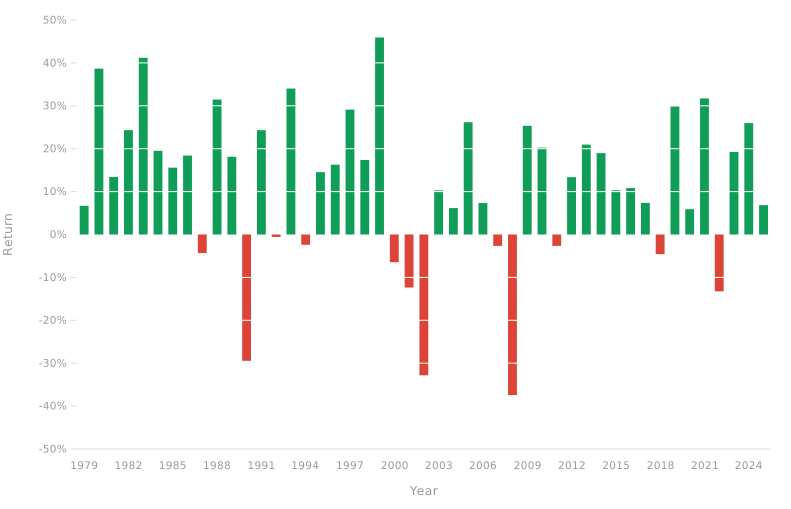
The returns of IWDA have been excellent throughout the years. An analysis on Backtest shows that it has returned an average 10.2% since 1979. If you had invested €10,000 in 1979, you would have had over €960,000 today.
The astute reader may have wondered how it's possible that the charts below start in 1979, even if IWDA wasn't created until 2009. The reason is that the analyses use the historical performance of its underlying MSCI World index, which exists for much longer. We then apply the total expense ratio of IWDA to get an approximation of IWDA's historical performance, had it existed since 1979.
Best and worst years
Due to IWDA investing only in stocks, you should expect some ups and downs. Its strongest year so far was 1999, when it jumped by 46%. But it also fell by 37% in 2008 during the financial crisis. It wasn’t easy to keep your head cool then.
Volatility like this is normal for a pure stock ETF. It’s the price you pay for higher long-term returns, and it’s why many investors choose to pair IWDA with bonds when they want a smoother experience.
Drawdown
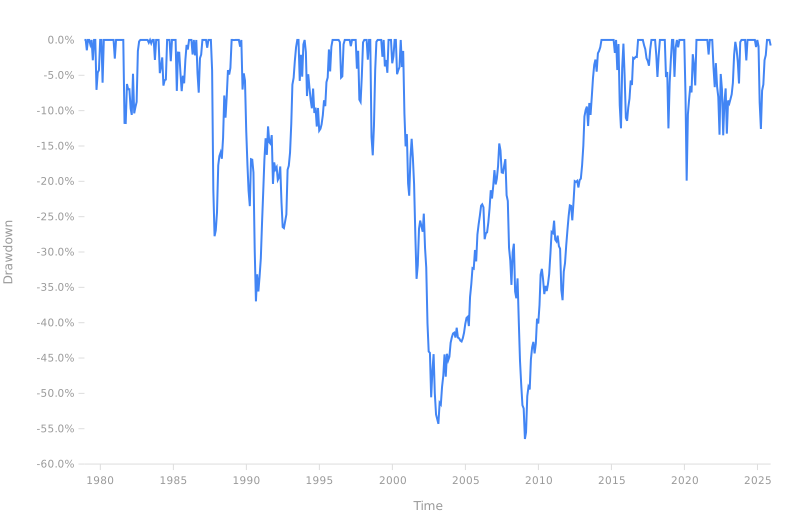
A drawdown shows how far a portfolio has fallen from its previous peak. It highlights the periods where you were “underwater”, meaning your investment had not yet recovered its past high.
For IWDA, the longest drawdown lasted more than 13 years, from August 2000 until May 2014. At its lowest point, the drop reached -56.5%. That’s a long time to wait for a recovery, and it shows just how bumpy a pure stock ETF can be. It also explains why many investors prefer to mix stocks and bonds when they want a more stable experience.
Minimum investment horizon
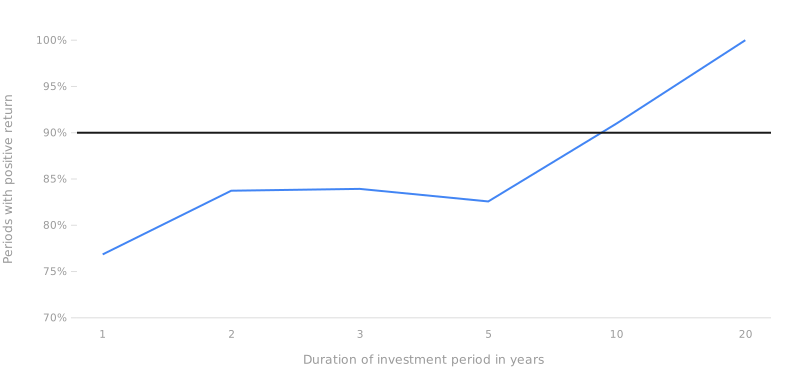
The longer you stay invested, the more likely you are to make money. The chart below shows the historical probability of earning a positive return when investing in IWDA for different holding periods.
For every 20-year period between 1979 and today, IWDA delivered a positive return. But if you zoom in to 3-year periods, only 84% ended in the green. This highlights something important. A stock ETF like IWDA can reward you well, but it asks for patience. A long investment horizon gives you a much better chance of success.
What are the risks of IWDA?
Even a “safe” global ETF comes with risks. IWDA spreads your money across many companies and countries, but it can still lose value. Here are the main risks you should be aware of.
Market risk
Stock markets can fall sharply. For example, we saw that IWDA experienced a 56% drop during its worst drawdown. When markets fall, a global ETF like IWDA falls too because it owns the companies inside those markets.
Currency risk (even when you buy IWDA in euro)
Many investors assume that buying the euro-denominated version of IWDA removes currency risk. It does not. Trading in euro simply avoids conversion fees at your broker.
IWDA still owns companies that earn their money in other currencies, especially US dollars. This means the euro-dollar exchange rate will influence your returns. Over long periods this effect usually evens out, but it can make a noticeable difference over shorter periods.
Concentration risk in the US and mega-cap companies
IWDA holds many companies, but the largest ones still have a big impact on performance. If the biggest US companies stagnate or fall for several years in a row, IWDA may underperform even when smaller companies are doing fine. Diversification helps, but it does not eliminate the influence of the giants.
Behaviour risk (which is often the biggest risk of all)
The most dangerous risk isn’t the ETF itself. It’s how you respond when markets move sharply. Buying IWDA is straightforward. Staying invested during a crash is much harder. When markets fall, the temptation to sell can be strong. But selling in a panic often locks in losses and makes it difficult to benefit from the recovery that usually follows. Keeping a long-term mindset is key, even when the short term feels uncomfortable.
If you can stay calm through the ups and downs, you greatly increase your chances of success.
Should you invest in IWDA?
IWDA is a great choice if you:
- Want a simple ETF for long-term stock investing
- Want a broad developed-market diversification
- Are looking for an accumulating ETF suitable for Belgian investors
- Are okay with missing emerging markets (or adding them later)
- Want something “boring and reliable” rather than thematic
IWDA may not be ideal if you want:
- Emerging markets included automatically
- A one-ETF "total-world" portfolio
- ESG filtering, meaning the exclusion of some "bad" companies
- Lower volatility (because you’re investing short-term)
How to invest in IWDA in Belgium
The steps are fairly simple, let's go through them:
- Choose a broker
- Choose the exchange
- Press that "Buy" button
Choose a broker
This is an important step. You need a broker to access the stock exchange where you can buy IWDA. Belgian brokers are usually more expensive, but they handle most of the administration for you, including taxes. Foreign brokers are often cheaper, but the responsibility for tax reporting shifts to you, which adds extra work and some risk if you make mistakes.
If you’re unsure which one fits you best, we made a full comparison to help you decide.
👉 Read our broker comparison for Belgians.
Choose the exchange
If you want to buy IWDA as a Belgian investor, the process is simple. You only need to choose the exchange where you buy it. The ETF always has the same ISIN code, IE00B4L5Y983, but the ticker changes depending on the exchange. That can be confusing the first time you see it, but it’s normal. You are still buying the same ETF.
Here are the tickers for "IWDA" you will find across exchanges:
| Exchange | Currency | Ticker |
|---|---|---|
| Euronext Amsterdam | EUR | IWDA |
| London Stock Exchange (LSE) | USD | IWDA |
| London Stock Exchange (LSE) | GBP | SWDA |
| Xetra (Germany) | EUR | EUNL |
| Borsa Italiana | EUR | SWDA |
| SIX Swiss Exchange | USD | SWDA |
The taxes for IWDA
The only two taxes applicable to IWDA are the transaction tax (TOB) and the capital gains tax:
| Tax | Rate |
|---|---|
| Transaction tax (TOB) | ❌ 0.12% per transaction |
| Dividend tax | ✅ None cause IWDA is accumulating |
| Capital gains tax | ❌ 10% with a €10,000 exemption |
| Reynders tax | ✅ None cause IWDA does not invest in bonds |
Transaction tax (TOB)
The TOB is a Belgian tax you pay every time you buy or sell an ETF. The TOB rate for ETFs is 0.12% or 1.32%. It depends on where the fund is registered, and whether it distributes dividends or reinvests them. To make things more confusing, the same ETF can sometimes be taxed differently depending on your broker. For IWDA, the correct TOB rate is 0.12%.
Still, always double-check what your broker applies:
- Belgian brokers like Bolero clearly show the TOB before you place an order.
- With foreign brokers like Trade Republic, you often have to calculate, declare, and pay the TOB yourself. That’s extra admin and extra risk if you make a mistake.
Capital gains tax
IWDA is also liable for the 10% capital gains tax. Fortunately, there's an annual €10,000 exemption.
Capital gains tax calculator
Calculating your capital gains tax is tricky. That’s why we built a tool that does it for you. It analyses your broker transactions and tells you exactly how much tax you owe, so you know what to declare.
Alternatives to IWDA
You're probably choosing between ETFs that are almost identical. They all give you global exposure, are low-cost and suitable for long-term investing. The real difference usually down what the index includes, such as the number of companies and which parts of the world are excluded (or not). Let's take a look at some of them.
If you’re looking at IWDA, you’re probably also looking at a few other ETFs that seem almost identical. They all give you global exposure, are low-cost, and are meant for long-term investing The real difference is usually what’s inside the index: how many companies are included, which parts of the world are covered, and whether small companies are included or not.
Let’s compare the most common options for Belgians.
IWDA vs Curvo Growth
IWDA is a single ETF. Curvo Growth is a complete investment option.
The Growth portfolio is a bit special because it's not a single ETF but a portfolio of funds. It's available through Curvo is and is a popular combination for Belgian investors who wish invest in the global economy for the long term. It's composed of two funds, both offered by Vanguard:
- A fund tracking the FTSE Developed All Cap Choice index (ISIN: IE00B5456744)
- A fund tracking the FTSE Emerging All Cap Choice index (ISIN: IE00BKV0W243)
Through the Growth portfolio, you invest in over 7,500 companies. The portfolio, one of five portfolios available, has returned approximately 8.5% annually since 2005.
With Curvo, you don’t have to build or manage an ETF portfolio yourself. After answering a few questions, we match you with a growth portfolio that fits your goals. Monthly investing, rebalancing, and admin are all handled for you.
IWDA vs IMIE
IWDA and IMIE are both popular ETFs for long-term investors, but they differ in how much of the world they cover.
As we now know, IWDA tracks the MSCI World index. It invests only in developed markets and only in large and mid-sized companies. This gives you solid diversification, but it isn’t fully global.
IMIE tracks the MSCI ACWI IMI index, which includes developed and emerging markets, as well as large, mid and small companies. In other words, IMIE offers broader diversification within a single ETF.
Because of this, many investors use IMIE as a one-ETF solution. Historically, IWDA has even performed slightly better at times. That’s normal. Different parts of the market take turns outperforming.
Conclusion: should you invest in IWDA?
IWDA gives you a simple way to own a piece of the global economy. It's cheap, well-managed, and covers more than a thousand companies across developed markets. For many Belgian investors, it's exactly what they need to start building wealth for the long term.
But simple doesn't mean easy. When markets drop 30% or more, staying invested takes discipline. The real challenge isn't picking the right ETF. It's sticking with it through the rough patches. If you can do that, IWDA is a solid foundation for your portfolio. And if you want help managing the ups and downs, or prefer a portfolio that includes bonds and emerging markets, options like Curvo can handle that for you.