


Revolut Robo-Advisor: the right choice for Belgians?
Revolut has become one of Europe's most popular financial apps. What started as a travel card to avoid bad exchange rates has grown into a full-blown super-app with banking, crypto, stock trading and more. Their latest addition is a robo-advisor that promises to manage your investments automatically from just €100.
It sounds appealing: open the app you already use for everyday banking, answer a few questions, and let an algorithm take care of your investments. But what's actually inside those portfolios?
We created an account and looked at every portfolio from the inside. We found sector bets on gold miners and the metaverse, heavy overlap between US index funds, and 19 ETFs in a single portfolio. Not what you'd expect from a product that promises simple, diversified investing.
The overview
| ✅ Benefits | ❌ Drawbacks |
|---|---|
| Low minimum investment (€100) | They don't handle your taxes |
| Affordable 0.75% management fee | Sector and thematic bets (gold miners, metaverse) |
| Automatic rebalancing | ~80% of ETFs from a single provider (Amundi) |
| Part of a broader financial super-app | TOB applies on every transaction |
| Spare change and recurring investment features | Mobile app only, no web platform |
| No securities transfer out (lock-in) | |
| Foreign account: NBB declaration required |
How Revolut's robo-advisor works
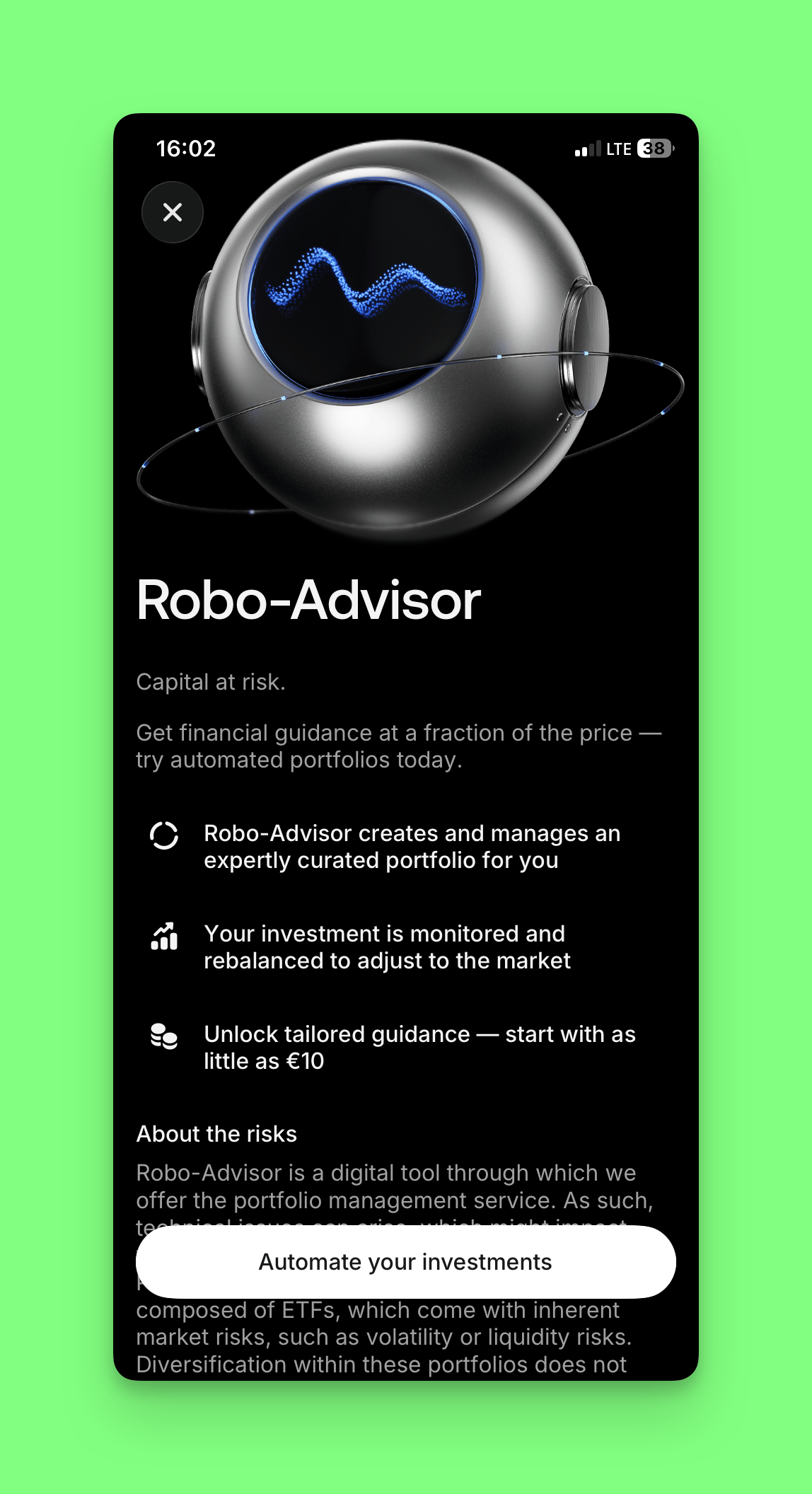
When you open the robo-advisor in the Revolut app, you start by completing a suitability questionnaire. It covers your investment objectives, risk tolerance, financial situation, investment knowledge and ESG preferences. Based on your answers, Revolut assigns you to one of its five model portfolios.
Your money is then invested in a portfolio of ETFs. Depending on the risk level, this can mean anywhere from 12 to 19 different funds. The algorithm automatically rebalances your portfolio on a monthly basis to keep the allocations aligned with the target. A human investment manager still oversees the general strategy, and can override the algorithm during extreme market events like a pandemic or financial crisis. You cannot manually choose specific regions or sectors. The robo-advisor is designed for simplicity, not for investors who want granular control over their portfolio.
Revolut offers two types of portfolios: Core portfolios and ESG portfolios which also consider environmental, social and governance factors. You choose between the two during the sign-up questionnaire via the app.
About Revolut
Revolut was founded in 2015 by Nikolay Storonsky and Vlad Yatsenko, originally as a foreign exchange and travel card app. Since then, it has grown rapidly into a financial super-app with over 45 million customers worldwide. In 2024, Revolut obtained a full banking licence in the UK. For Belgian investors looking to invest, the important entity is Revolut Securities Europe UAB, a Lithuanian investment firm regulated by the Bank of Lithuania. This is the company that provides the robo-advisor service. It's not a Belgian company and it's not directly regulated by the FSMA, although it is registered with the FSMA to offer its services in Belgium through EU passporting. Revolut recently opened a bank branch in Belgium but it's not applicable for their investment services.
The portfolios
Revolut offers five portfolios, each with a different risk level:
| Portfolio | Risk | Stocks | Bonds | Cash | Number of ETFs |
|---|---|---|---|---|---|
| Defensive | 1/5 | 7% | 92% | 1% | 12 |
| Slow and Steady | 2/5 | 31% | 68% | 1% | 15 |
| Balanced Bundle | 3/5 | 63% | 36% | 1% | 19 |
| Bold Stack | 4/5 | 85% | 14% | 1% | 16 |
| Aggressive Growth | 5/5 | 99% | 0% | 1% | 13 |
Allocations based on our observation of the portfolios in May 2026. Revolut states that portfolios are "dynamically tailored", so the exact compositions change over time.
Dominated by Amundi
Roughly 80% of the ETFs across all portfolios come from a single provider: Amundi. A few iShares, UBS, Xtrackers and Invesco funds fill the gaps. Most independent robo-advisors use funds from multiple providers. Relying this heavily on one raises the question of whether the selection was driven by fund quality or by a commercial arrangement with Amundi.
Sector bets in a "passive" product
Every portfolio contains sector and thematic ETFs that are unusual for a product built on passive investing. These are active calls on which sectors will outperform. If you're choosing a robo-advisor for hands-off, diversified investing, you probably don't expect a 2% gold mining tilt or a "metaverse" allocation in your portfolio.
Heavy US overlap
The stock portion uses three separate US funds: Amundi S&P 500 II (unhedged), Amundi S&P 500 II EUR Hedged, and Amundi Nasdaq-100 II. In the Bold Stack portfolio, these add up to 33.5% of total assets. But the overlap between them is large: roughly 80% of the Nasdaq-100 is already part of the S&P 500. Holding both means you're tripling down on mega-cap US tech companies.
Holding both a hedged and unhedged S&P 500 fund in the same portfolio is also a strange choice. Either you hedge dollar exposure or you don't. Holding both is a half-measure that serves no clear purpose.
No simple global index fund
The most common building block for European index investors is a single fund tracking the MSCI World or FTSE All-World index. Revolut doesn't use one. Instead, it builds global equity exposure by stitching together separate US, European, Japanese, emerging market, Pacific and thematic ETFs. More moving parts, more rebalancing transactions, and no clear diversification benefit over a single global fund.
The Balanced Bundle in detail
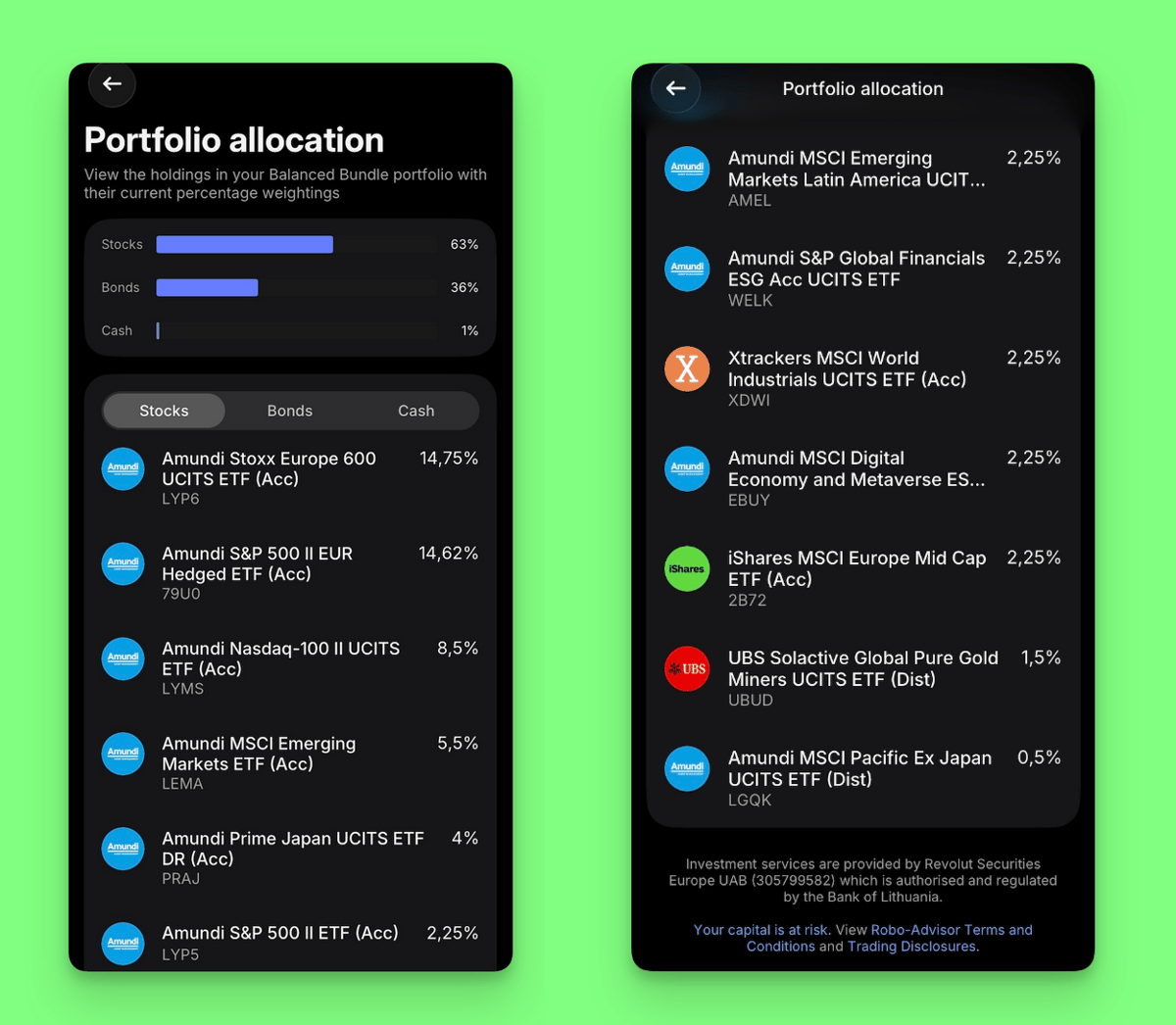
To illustrate the complexity, here is the full composition of the Balanced Bundle (risk 3/5):
Stocks (64% across 13 ETFs)
| ETF | Weight |
|---|---|
| Amundi Stoxx Europe 600 (Acc) | 14.75% |
| Amundi S&P 500 II EUR Hedged (Acc) | 14.62% |
| Amundi Nasdaq-100 II (Acc) | 8.50% |
| Amundi MSCI Emerging Markets (Acc) | 5.50% |
| Amundi Prime Japan (Acc) | 4.00% |
| Amundi S&P 500 II (Acc) | 2.25% |
| Amundi MSCI EM Latin America (Acc) | 2.25% |
| Amundi S&P Global Financials ESG | 2.25% |
| Xtrackers MSCI World Industrials (Acc) | 2.25% |
| Amundi MSCI Digital Economy & Metaverse | 2.25% |
| iShares MSCI Europe Mid Cap (Acc) | 2.25% |
| UBS Solactive Gold Miners (Dist) | 1.50% |
| Amundi MSCI Pacific Ex Japan (Dist) | 0.50% |
Bonds (36% across 6 ETFs)
| ETF | Weight |
|---|---|
| Amundi Prime Euro Govies (Acc) | 9.00% |
| Amundi EUR Corporate Bond (Acc) | 8.50% |
| Invesco US Treasury Bond 7-10Y EUR-hedged (Dist) | 7.75% |
| Amundi USD EM Government Bond (Acc) | 5.75% |
| Amundi EUR High Yield Corporate Bond (Acc) | 3.63% |
| iShares J.P. Morgan EM Local Government Bond | 1.50% |
The remaining 1% is for cash (to cover the Revolut fees). In total, that's 19 different ETFs plus a cash position for a single portfolio. For comparison, most index-based robo-advisors achieve global diversification across thousands of companies with 2 to 5 funds.
How the other portfolios differ
The five portfolios use the same set of ETFs with different weights. As risk increases, bonds shrink and sector bets grow:
- The Defensive portfolio (12 ETFs) puts 92% in bonds but a third of that goes to high-yield corporate bonds (20.4%) and USD emerging market government bonds (15.4%).
- Slow and Steady (15 ETFs) is a more conventional 31/68 stock-bond split.
- Bold Stack (16 ETFs) pushes stocks to 85% and keeps only three bond funds.
- Aggressive Growth (13 ETFs) drops bonds entirely: 99% stocks with the sector bets at their highest: financials at 9.9%, industrials at 7.2%, and the metaverse fund at 4.5%.
"Defensive" is less defensive than it sounds
The Defensive portfolio allocates 92% to bonds, which sounds safe. But look at the bond composition: 20.4% goes to high-yield corporate bonds and 15.4% to USD emerging market government bonds. That's over a third of the portfolio in riskier fixed income. Someone choosing the "Defensive" option likely doesn't expect that much exposure to those types of bonds and emerging market debt.
Accumulating stocks, but some distributing bonds
The stock ETFs are mostly accumulating, which is good news for Belgian investors. Dividends are reinvested within the fund, which avoids the 30% dividend tax that distributing funds trigger. The exceptions are the UBS Gold Miners ETF and the Amundi Pacific Ex Japan ETF, which are both distributing. On the bond side, the Invesco US Treasury Bond ETF and some iShares bond funds also distribute. The dividend tax hit is smaller than if all funds were distributing, but it's still there.
Fees
Revolut charges an annual management fee of 0.75%, calculated monthly based on the average daily balance of your portfolio. This fee covers portfolio management, rebalancing, custody and transactions. There is no performance fee, no entry fee and no exit fee.
On top of the management fee, the underlying ETFs have their own costs (the TER, or total expense ratio). For the ETFs used in the Bold Stack, these range from roughly 0.20% to 0.50% per fund. You don't pay these separately; they're deducted from the fund's performance.
So the total annual cost is approximately 1.00% to 1.25%, depending on your portfolio. This is in the same ballpark as other robo-advisors like MeDirect MeManaged (1.3%) but more expensive than buying ETFs yourself through a broker.
Convenience
Taxes
This is where things get complicated for Belgian investors. While Revolut has a banking branch in Belgium, the robo-advisor is provided by a separate entity: Revolut Securities Europe UAB, registered in Lithuania. Because your investments are held through this Lithuanian entity, Revolut does not handle any Belgian taxes for you. You are fully responsible for declaring and paying them yourself.
Here's what you need to deal with:
- TOB (transaction tax): every time ETFs are bought or sold in your portfolio (including during rebalancing), the Belgian transaction tax applies. You need to declare and pay this yourself. With 12 to 19 ETFs per portfolio and monthly rebalancing, that's a lot of potential taxable events.
- Dividend tax: most of the stock ETFs are accumulating, so they don't trigger dividend tax. But a few holdings are distributing (the UBS Gold Miners ETF, some bond funds), and for those the 30% dividend withholding tax applies. You need to handle this yourself.
- Reynders tax: when you sell funds that contain more than 10% bonds, you owe 30% tax on the gains from the bond portion. All of Revolut's portfolios except Aggressive Growth have a significant bond allocation, so this tax is likely to apply.
Revolut does provide monthly profit and loss statements and an annual consolidated statement that you can download from the app (under Documents and statements). These help with filing your tax return, but the actual declaring and paying is on you.
With up to 19 ETFs in a single portfolio and monthly rebalancing, the number of individual transactions you need to track can add up quickly. The tax complexity is a clear downside compared to services that handle taxes for you.
With Curvo, you invest in TOB-exempt accumulating funds and get the exact figures for your yearly tax declaration. No need to track transactions across 19 ETFs yourself. Learn how Curvo works.
You needto declare your Revolut account to the NBB
Yes. Since Revolut Securities Europe UAB is a Lithuanian entity, Belgian residents must declare the account to the National Bank of Belgium (NBB) and include it on their annual tax return. We wrote a detailed guide on how to declare a Revolut account in Belgium.
Automated savings plans
Revolut offers scheduled investments on a daily, weekly, monthly or quarterly basis. A manual top-up requires a minimum of €10. There's also a "spare change" feature that rounds up your debit card purchases and invests the difference. If you buy a coffee for €2.59, the remaining €0.41 gets invested. You can even activate an "accelerator" that multiplies the spare change amount by up to 10x.
Customer support
Support is available through in-app chat but it's not human led. You mainly chat to an AI agent. There is no dedicated phone line for Belgian customers.
Fractional shares are supported
Yes, fractional shares are supported. All your money gets invested, with no cash sitting idle.
Platform
The robo-advisor is only available through the Revolut mobile app (iOS and Android). Revolut does have a web app, but it's limited to basic features like viewing accounts and downloading statements. The robo-advisor and other investment products are not supported on the web platform.
Ease of use: 3/5
If you already use Revolut for everyday banking, the robo-advisor is easy to set up. The suitability questionnaire takes a few minutes, and the entire process happens within the app. The interface is clean and easy to navigate. It loses a couple of points because of the tax complexity. For Belgian investors, dealing with TOB, dividend tax and Reynders tax declarations is an administrative burden that the app does nothing to help with.
Setting up an account
| Account opening time | Minutes (within the Revolut app) |
| Minimum investment | €100 |
| itsme | Yes |
| Children's accounts | No |
| Joint accounts | No |
| Multiple portfolios | No |
Getting started
You need a Revolut account to use the robo-advisor. If you already have one, you can set up the robo-advisor directly within the app. The minimum investment is €100, which is lower than the €5,000 required by other robo advisors.
After the initial investment, you can add as little as €10 at a time, either manually or through automated scheduling.
There's itsme
Like most Belgian financial apps, Revolut supports itsme for identity verification. You can also run verification through the app's own process, which involves uploading an ID document and taking a selfie.
No children or joint accounts
Revolut's robo-advisor is only available to individuals aged 18 and over. There are no options for children's accounts or joint investment accounts.
Is Revolut safe?
| Regulator | Bank of Lithuania |
| FSMA registered | Yes (EU passport) |
| Past regulatory issues | None found |
| Investor protection | €22,000 |
| Securities lending | No |
| Payment for order flow | No |
Regulated by the Bank of Lithuania
Revolut Securities Europe UAB is authorised and regulated by the Bank of Lithuania, which is a member of the Eurosystem. It operates in Belgium through EU passporting, meaning it can offer its services across the EEA without needing a separate licence in each country. The entity is registered with the FSMA, but the primary oversight comes from Lithuania.
This matters because if something goes wrong, you'd be dealing with Lithuanian regulators and dispute resolution, not Belgian ones. That's a real difference compared to Belgian-regulated services.
No securities lending or payment for order flow
Revolut confirmed that they don't engage in securities lending with the ETFs in your portfolio. They also don't use payment for order flow (PFOF), as EEA regulations require them to act in your best interest when routing orders.
Investor protection: €22,000
Your investments are protected up to €22,000 through the Lithuanian Deposit and Investment Insurance Scheme. This covers you if Revolut Securities Europe UAB becomes insolvent (meaning it can't return your assets). It does not protect against market losses.
Your securities are held in segregated accounts, meaning they're kept separate from Revolut's own assets. If Revolut goes bankrupt, your investments should be returned to you in full, regardless of the €22,000 limit.
Can you transfer securities out?
According to Revolut's terms and conditions, you cannot transfer financial instruments into or out of your robo-advisor portfolio. If you want to stop using the service, your only option is to sell everything and withdraw the cash. This is a lock-in worth considering before you invest a large amount.
A better alternative for Belgians: investing through Curvo
We built Curvo to make investing simple for Belgians. Like Revolut's robo-advisor, Curvo manages your portfolio automatically. But the approach is different.
Broad index funds instead of "bets"
The Curvo portfolios are built on index funds that track the global economy. Instead of specific sector bets on financials, industrials or gold miners, you're invested in over 7,500 companies across all sectors and regions. The portfolios use 2 to 5 funds from multiple providers (Vanguard, iShares, Amundi) rather than 19 ETFs dominated by a single one.
When you sign up, you answer a few questions about your goals, investment horizon and risk tolerance. Based on your answers, you're matched with the portfolio that's best for you.
Tax-efficient for Belgians
Curvo only invests in accumulating funds, which means dividends are reinvested automatically within the fund. This avoids the 30% dividend tax that distributing funds trigger. Revolut's stock ETFs are mostly accumulating too, but the portfolios still include a few distributing funds (the gold miners ETF, some bond funds).
The bigger difference is the transaction tax (TOB). The funds in Curvo portfolios are not subject to TOB. This saves you between 0.12% and 1.32% on every transaction. With Revolut, TOB applies on every buy and sell, including during monthly rebalancing. With up to 19 ETFs per portfolio, that's a lot of transactions.
Curvo also provides the exact figures for your yearly tax declaration and offers step-by-step guides to walk you through it.
Sustainability built in
Curvo doesn't invest in companies that are considered destructive to the planet. Sectors like non-renewable energy, weapons and tobacco are excluded.
Start from €50
Curvo's minimum investment is €50, compared to €100 for Revolut. And you can set up automated monthly investments through direct debit.
Conclusion
Revolut's robo-advisor is a convenient option if you already use the app and want an easy way to start investing. The €100 minimum, the 0.75% management fee and features like spare change investing make it accessible for beginners. But the portfolios are more complex than they first appear. When we looked inside, we found 12 to 19 ETFs per portfolio, mostly from a single provider (Amundi), with sector and thematic bets on gold miners, the metaverse and financial stocks. That's not the simple, diversified index investing that most people expect from a robo-advisor. For Belgian investors, the tax situation adds to the complexity. You're responsible for handling TOB, dividend tax and Reynders tax yourself. With monthly rebalancing across that many ETFs, the administration adds up. And your account needs to be declared to the NBB.
If you'd rather invest in broad index funds without sector bets and with fewer tax headaches, have a look at Curvo. Your portfolio uses TOB-exempt, accumulating funds, and you get help with your tax declaration. You can get started from just €50.