


Best iShares ETFs for Belgians in 2026
iShares is the biggest ETF brand in the world. BlackRock built it into a range of more than 400 European funds, and most Belgian investors have at least one iShares ETF in their portfolio.
That scale is also the problem. With so many iShares funds listed across European exchanges, picking the right one for your situation gets confusing fast. Pick a niche thematic fund and you might wonder later if a global tracker would have done the job at a quarter of the cost.
So we went through the range and picked the iShares ETFs we think make sense for a Belgian investor in 2026. Five funds covering global stocks, the US, emerging markets, a one-ticker world option, and bonds. Plus an honest look at when none of them is the right answer.
Why iShares ETFs are popular with Belgian investors
BlackRock manages around $13 trillion in assets globally. iShares alone holds over €1 trillion in Europe. That scale matters because it means most iShares ETFs are big, liquid and cheap to trade. The "Core" range of ETFs have very low fees. iShares Core MSCI World, Core S&P 500 and Core MSCI EM IMI are all under 0.20% in ongoing charges.
Yet, iShares is cheap but not always the cheapest. SPDR, Amundi, Invesco and Vanguard can undercut iShares on at least one popular index.
How to pick a good iShares ETF
Before listing the picks, here's what we screen for in a good ETF. You can use the same criteria when looking at any ETF, not just iShares.
- Irish domicile. Better US dividend treatment.
- Accumulating share class. Dividends roll back into the fund instead of being paid out. Belgium withholds 30% on distributed dividends, so accumulating means more compounding for you.
- Physical replication. The fund actually owns the underlying shares or bonds, not a synthetic swap. Less counterparty risk.
- At least €100 million in assets. Below that, BlackRock might close the fund and force a taxable event.
- The right TOB rate. Most iShares Ireland-domiciled ETFs registered in the EEA pay 0.12% Belgian transaction tax. A handful registered with the Belgian FSMA pay 1.32%. The same fund can have both rates depending on the listing your broker uses, so double-check before you buy. See our guide to the TOB.
The Curvo portfolios sidestep the TOB problem entirely. None of the funds carry the Belgian transaction tax, no matter how often you buy. One less number to worry about.
The best iShares ETFs for Belgians
1) iShares Core MSCI World (IWDA)
| Index | MSCI World |
| Tickers | IWDA / EUNL / SWDA |
| Distribution policy | Accumulating |
| Number of holdings | 1,315 |
| Domicile | Ireland |
| Total expense ratio (yearly cost) | 0.20% |
| Fund size | €115.9 billion |
| ISIN | IE00B4L5Y983 |
The default global stock ETF for Belgian investors. If you only buy one iShares fund in your life, this is the one to consider.
It covers around 85% of developed-market equity in a single fund by tracking the MSCI World index. It's liquid on every Belgian broker. The 0.20% TER is among the cheapest for a global ETF, and the accumulating share class compounds your dividends without triggering the 30% Belgian withholding.
The trade-offs are concentration and coverage. US stocks make up around 70% of the index, China, India, Brazil and Taiwan are absent, and small caps aren't included.
An analysis on Backtest shows IWDA has returned an average of 8.0% per year since 1969. €10,000 invested in 1969 would be over €750,000 today.
For a deeper look, read our IWDA review. And for how IWDA compares to the SPDR alternative, see SWRD vs IWDA.
2) iShares Core S&P 500 (CSPX)
| Index | S&P 500 |
| Tickers | CSPX / SXR8 |
| Distribution policy | Accumulating |
| Number of holdings | 503 |
| Domicile | Ireland |
| Total expense ratio (yearly cost) | 0.07% |
| Fund size | €119.8 billion |
| ISIN | IE00B5BMR087 |
This is the cheapest large iShares fund. The 0.07% price tag is hard to argue with.
It tracks the 500 biggest US companies in the S&P 500 index via full physical replication, not sampling. The fee is 13 basis points lower than IWDA, which compounds nicely over decades.
The trade-off is concentration. CSPX is 100% US and large-cap only, and however strong past performance has been, it doesn't promise the next 30 years.
An analysis on Backtest shows CSPX has returned an average of 10.8% per year since 1992.
3) Curvo Growth (bonus)
| Index | FTSE Developed All Cap Choice FTSE Emerging All Cap Choice |
| Distribution policy | Accumulating |
| Number of companies | 7,504 |
| Number of countries | 49 |
| Sustainable | Yes |
| Total cost | From 0.6% all-in per year |
| Belgian transaction tax (TOB) | None |
| Minimum investment | €50 |
Curvo Growth is a managed portfolio built on Vanguard funds, not iShares. We're including it because the question "which iShares ETF should I buy?" often hides a different one: do you actually want to pick?
If you'd rather not toggle between IWDA, IMIE and SSAC, work out the right ratios, rebalance, or worry about which TOB rate applies, a managed portfolio like Curvo Growth handles all of that in the background.
The honest trade-off is cost. Curvo's 1% all-in fee is meaningfully higher than 0.20% for IWDA. You're paying for the automation, the rebalancing, the automated monthly investing and the tax handling. If you'd never set those things up yourself, the extra cost is probably worth it. If you're happily running your own portfolio of ETFs through a broker, stick with that.
4) iShares Core MSCI Emerging Markets IMI (IMIE)
| Index | MSCI Emerging Markets IMI |
| Tickers | IMIE / EMIM / IS3N |
| Distribution policy | Accumulating |
| Number of holdings | 2,958 |
| Domicile | Ireland |
| Total expense ratio (yearly cost) | 0.18% |
| Fund size | €34.0 billion |
| ISIN | IE00BKM4GZ66 |
This is the emerging-markets piece most Belgian investors pair with IWDA.
It's the cheapest broad emerging markets ETF in Europe. The "IMI" in the name means it covers small caps as well as large and mid, so the holdings list is wider than a vanilla MSCI EM tracker. €34 billion in AUM means it isn't going anywhere.
The trade-offs are volatility and concentration. 30% drawdowns happen, and China is around a quarter of the index.
If you hold IWDA and want to add emerging markets, an 88/12 split between IWDA and IMIE roughly mimics MSCI ACWI exposure. We compare them side by side in IMIE vs IWDA and our iShares Core MSCI EM IMI review.
5) iShares MSCI ACWI (SSAC)
| Index | MSCI ACWI |
| Tickers | SSAC / IUSQ |
| Distribution policy | Accumulating |
| Number of holdings | 2,348 |
| Domicile | Ireland |
| Total expense ratio (yearly cost) | 0.20% |
| Fund size | €25.4 billion |
| ISIN | IE00B6R52259 |
SSAC is the "one ETF for everything" option. It holds developed and emerging markets in a single fund at the same 0.20% TER as IWDA. No need to rebalance two ETFs.
The trade-offs are size and scope. SSAC has €25 billion in AUM, a fraction of IWDA's, and like IWDA it skips small caps.
An analysis on Backtest shows SSAC has had an average compound annual growth rate of 8.6% since 1988.
The trade-off versus an IWDA + IMIE combo is small. SSAC saves you the rebalancing decision. The combination gives you slightly tighter control over your EM weighting. We dig into both in MSCI ACWI vs MSCI World.
6) iShares Core Global Aggregate Bond EUR Hedged (AGGH)
| Index | Bloomberg Global Aggregate Bond (EUR Hedged) |
| Tickers | AGGH / EUNA |
| Distribution policy | Accumulating |
| Number of holdings | 19,607 |
| Domicile | Ireland |
| Total expense ratio (yearly cost) | 0.10% |
| Fund size | €2.4 billion |
| ISIN | IE00BDBRDM35 |
AGGH is the bond piece for investors who to diversify into a different asset class and want to dampen volatility.
It holds 19,000+ government and corporate bonds across the major developed economies, hedged to euro so currency risk doesn't pile on top of bond risk. It's one of the most diversified bond funds available to retail investors.
The trade-offs are returns and tax. Bonds aren't there to make you rich, they're there to keep the portfolio steady when stocks fall. And in Belgium, capital gains on the bond portion of any fund are taxed at 30% due to the Reynders tax.
Not sure how much of your portfolio should be bonds? When you sign up to Curvo, we ask a few questions about your goals, time horizon and tolerance for risk, then match you with the right portfolio. If bonds belong in your mix, they'll be in there.
If you're decades from retirement, you might skip bonds entirely. As you get closer to needing the money, AGGH becomes the right hedge.
Comparison between iShares ETFs
| Fund | TER | Holdings | TOB | Best for |
|---|---|---|---|---|
| IWDA (MSCI World) | 0.20% | 1,315 | 0.12% | Default global core |
| CSPX (S&P 500) | 0.07% | 503 | 0.12% | US equity slice |
| Curvo Growth | 0.6% to 1.0% all-in | 7,500+ | 0% | Hands-off investing |
| IMIE (EM IMI) | 0.18% | 2,958 | 0.12% | Emerging markets |
| SSAC (ACWI) | 0.20% | 2,348 | 0.12% | One-ticker world |
| AGGH (Bonds, EUR Hedged) | 0.10% | 19,607 | 0.12% | Stability |
The Belgian tax traps to watch out for
Three traps catch new investors more than any others:
- Buying the wrong listing of the right ETF. A handful of iShares ETFs have a "Belgian" share class with a higher 1.32% TOB. The fund is the same but the tax bill is more than 10x higher. Always check before buying.
- Accidentally choosing a distributing share class. A distributing ETF pays you dividends every quarter, and Belgium withholds 30% of each one. The accumulating version reinvests them tax-free until you sell.
- Forgetting the Reynders tax on bond ETFs. AGGH and any other ETF with more than 10% bonds triggers the 30% Reynders tax on the bond portion's capital gains. It doesn't apply to pure stock ETFs like IWDA.
How to actually buy these ETFs in Belgium
Three steps, in order:
- Pick a Belgian-friendly broker. Bolero, MeDirect, Saxo and Lynx all let you buy iShares ETFs. Costs and features differ. Our broker guide for beginners walks through the trade-offs.
- Find the right listing. The same iShares ETF is often listed on Xetra (Germany), Euronext Amsterdam, the LSE and Borsa Italiana. Pick a euro-denominated listing on a market your broker doesn't charge extra for.
- Automate it. Set up a monthly buy and stop watching the price.
When you might skip iShares ETFs entirely
iShares is excellent, but it isn't the right choice for every Belgian investor.
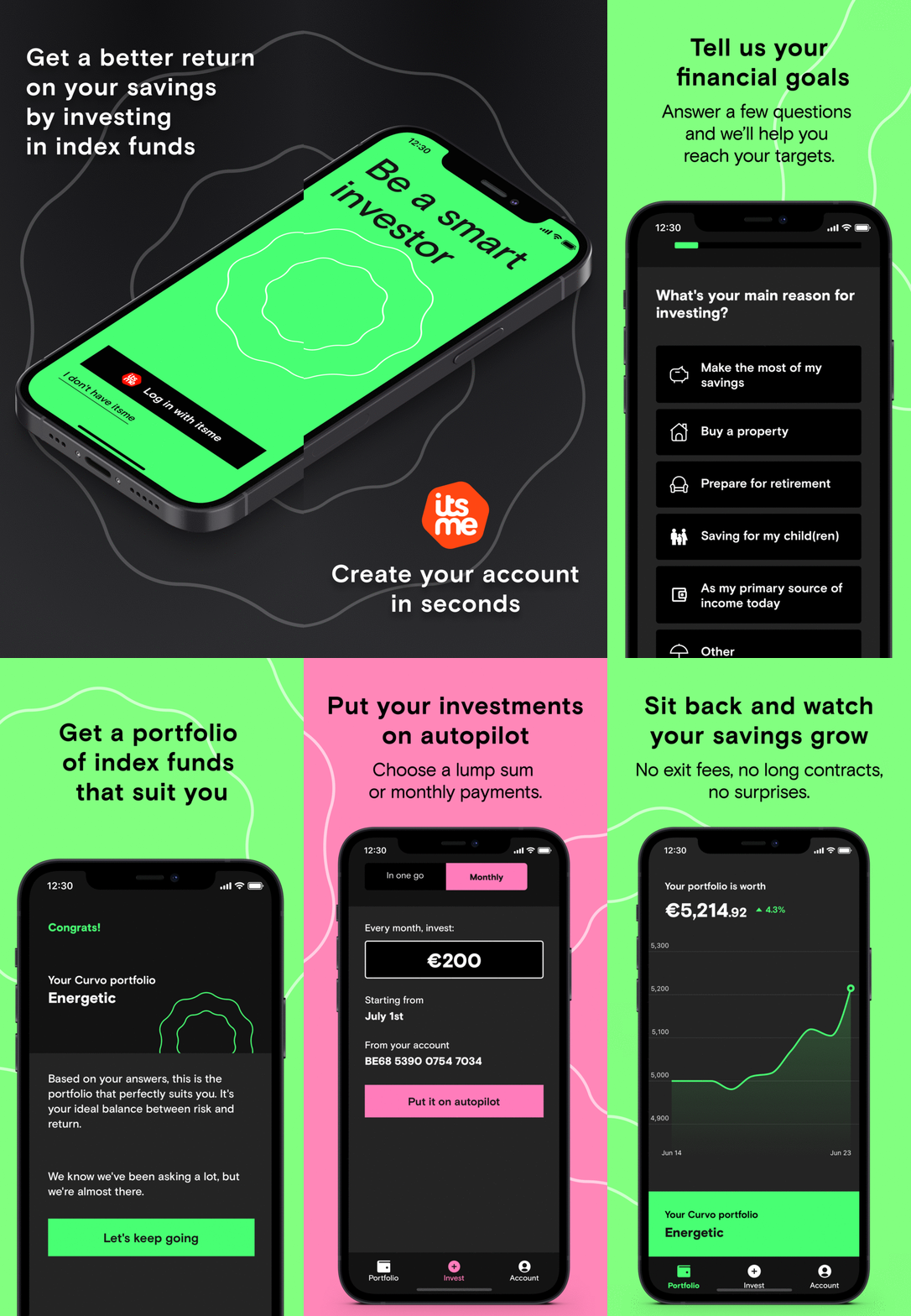
If you'd rather not pick funds, manage rebalancing, or worry about which TOB rate applies, a portfolio service like Curvo handles those decisions for you. The trade-off is the higher all-in cost (between 0.6% and 1.0% vs 0.2% for IWDA), but you get sustainable index investing, automatic monthly contributions, no Belgian transaction tax and a starting amount of €50. Curvo co-founders Thomas and Yoran built it for exactly the people who don't want to spend their evenings trying to figure out which ETF fits best into their portfolio.
Learn more on how Curvo works.
Our conclusion
iShares gives Belgian investors a deep range of ETFs at low cost. Five of them cover almost every reasonable long-term portfolio: IWDA for developed-market stocks, CSPX for the US slice, IMIE for emerging markets, SSAC if you'd rather hold a single fund, and AGGH for bonds.
The picks matter less than the discipline. The iShares fund range is good enough that almost any sensible combination will outperform a savings account over 20 years, as long as you keep buying through the dips. The traps to watch are the Belgian-specific ones: TOB rates, distributing share classes and the Reynders tax on bonds.
If you want to invest in iShares ETFs yourself, open an account with a Belgian-friendly broker and set up a monthly buy. If you'd rather not think about ratios, rebalancing or which listing has the right TOB, a managed service like Curvo does that work for you, with sustainable global index funds, no transaction tax and €50 to get started.