


VGLA review: the cheapest world ETF for Belgians?
Vanguard has just launched VGLA, a world ETF that costs 0.07% a year. That is half the price of VWCE, and it holds thousands of small companies that VWCE leaves out. On paper it is the cheapest way to own the whole world stock market in a single fund.
Then you look at the Belgian transaction tax. VGLA carries a TOB of 1.32%, eleven times the 0.12% you pay on some rival world ETFs. You pay it on every purchase and again when you sell.
VGLA is still a clear upgrade if you were going to buy VWCE. Against a cheaper-to-tax ETF like IMIE, the maths is much closer than the headline suggests. Here is what you need to know before you place an order.
Verdict: is VGLA good for Belgian investors?
Yes, if VWCE was your plan. VGLA does everything VWCE does, adds thousands of small companies, and charges half the annual fee. The TOB is identical at 1.32%, so nothing is lost in the swap.
The picture changes if you were choosing between VGLA and an ETF taxed at 0.12%. The 1.32% TOB costs you more up front than the lower yearly fee gives back for over a decade.
VGLA suits you if:
- You want one ETF that owns almost the entire world stock market, small caps included.
- You invest large amounts at a time rather than small monthly orders.
- You plan to hold for a very long time and rarely sell.
VGLA suits you less if:
- You buy every month with a few hundred euros, because you pay the 1.32% TOB on every single order.
- You want the lowest total cost of ownership in Belgium over the next ten years.
What is VGLA?
VGLA is the ticker for the Vanguard FTSE Global All-Cap UCITS ETF (USD) Accumulating, an Irish ETF that tracks the FTSE Global All Cap index. Vanguard listed it on 20 August 2026. It is a sub-fund of Vanguard Funds plc, the same umbrella that holds VWCE.
| Name | Vanguard FTSE Global All-Cap UCITS ETF (USD) Accumulating |
| ISIN | IE000VAHT5T0 |
| Domicile | Ireland |
| Dividend policy | Accumulating |
| TER | 0.07% / year |
| Index | FTSE Global All Cap |
| Inception date | 18 August 2026 |
| Replication | ✅ Physical, using sampling |
| Provider | ✅ Vanguard |
| TOB in Belgium | 1.32% |
The fund does not buy every share in the index. It holds a representative sample, which is normal for an index this wide. Vanguard also lends out securities from the fund to earn extra income, as set out in its Key Investor Information Document.
What is inside the FTSE Global All Cap index?
The FTSE Global All Cap index held 10,126 companies on 31 July 2026, according to Vanguard's factsheet for its UK fund tracking the same index. It covers large, mid-sized and small companies in both developed and emerging markets.
That last part is what separates it from the FTSE All-World index behind VWCE. FTSE All-World stops at large and mid-sized companies, so VWCE held 3,782 stocks on 31 July 2026. VGLA owns those same companies plus roughly six thousand smaller ones.
Small caps are companies like a regional engineering firm or a mid-sized software business. Together they are a small slice of the market by value, but they are thousands of real businesses that most world ETFs skip.
Owning them has barely changed the outcome so far. Since October 2016, the FTSE Global All Cap index, which also includes global small caps, and the FTSE All-World, which does not, finished within 0.1% a year of each other in our Backtest data to 31 July 2026. Small caps make your ETF more complete. They have not made it noticeably richer, at least during that period.
VGLA costs 0.07% a year
VGLA charges an ongoing cost of 0.07% per year, confirmed in Vanguard's Key Investor Information Document. On a €50,000 portfolio, that is €35 a year.
This matches the cheapest global equity ETFs in Europe. The Amundi Prime All Country World (IE0003XJA0J9) also charges 0.07%, but it tracks the Solactive GBS Global Markets Large & Mid Cap index, which leaves out small caps. VGLA is the cheapest world ETF that includes them.
For comparison, VWCE charges 0.14% and IMIE charges 0.17%. Over decades those gaps compound. They are also much smaller than the tax you pay to get in.
The TOB on VGLA is 1.32%
Belgium charges a 1.32% transaction tax on VGLA, both when you buy and when you sell. That is the highest of the three TOB rates and it applies to every order you place.
The reason is a quirk of Belgian tax law. The TOB rate for an ETF depends on whether the fund is registered in Belgium and on whether it pays out dividends. Once one compartment of a fund is registered in Belgium, the tax authorities treat every compartment as registered. VGLA is a sub-fund of Vanguard Funds plc, which has compartments registered in Belgium, and VGLA is accumulating. That combination lands on 1.32%.
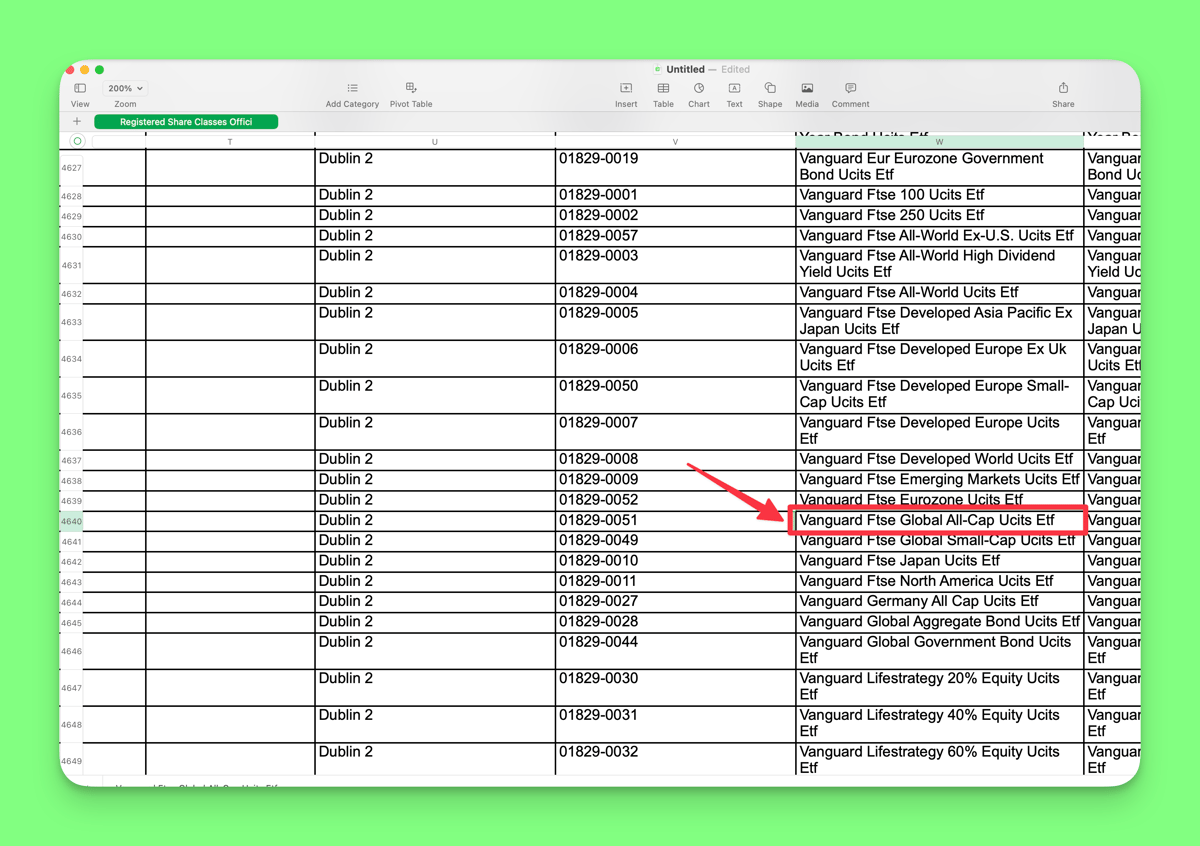
Here is what that costs in practice:
- Buy €10,000 of VGLA and you pay €132 in tax. The same purchase of IMIE costs €12, because IMIE is taxed at 0.12%.
- Invest €500 a month for 20 years and you hand over €1,584 in TOB along the way. With IMIE it would be €144.
- Sell a portfolio worth €250,000 and the TOB on the sale is €3,300. With IMIE it would be €300.
The 0.10% a year that VGLA saves you against IMIE takes about twelve years to earn back that €120 gap on a single purchase. Sell before then and you never get there, because you pay the 1.32% again on the way out.
If you use a Belgian broker, the tax is withheld for you. With a foreign broker you usually have to handle the TOB declaration yourself, which is extra admin every two months.
The TOB is the tax most Belgian ETF investors forget to budget for, and 1.32% is a lot to pay before your money is even invested. The funds in the Curvo portfolios are exempt from it. That is exactly why we use institutional index funds rather than ETFs.
Dividend tax and capital gains tax on VGLA
VGLA is accumulating, so you pay no Belgian dividend tax on it. The fund reinvests the dividends from its 10,000 companies internally instead of paying them into your account, and Belgium's 30% dividend withholding tax only applies to cash that reaches you.
Accumulating does not mean the dividends disappear. They are reinvested for you inside the fund. The fund also loses some withholding tax at source on foreign dividends, and that is already reflected in the price you see.
VGLA falls under Belgium's 10% capital gains tax, which started on 1 January 2026. The first €10,000 of gains each year are exempt, and any gain you made before 2026 stays untaxed.
Capital gains tax calculator
Working out what you owe is fiddly. Our calculator reads your broker transactions and tells you the amount to declare.
VGLA vs VWCE
VGLA beats VWCE on every measure that matters. Both are Vanguard, both are Irish, both are accumulating, and both carry the same 1.32% TOB. VGLA charges 0.07% against VWCE's 0.14%, and it owns around 10,000 companies against VWCE's 3,782.
There is no Belgian tax argument for VWCE over VGLA. The two funds sit under the same umbrella, so the transaction tax is identical. If you are starting today and you like the VWCE approach, VGLA is the better version of it.
The one thing VWCE has is history. It has been trading since 2019 and holds tens of billions of euros, so its spreads are tight and predictable. VGLA started from zero on 18 August 2026.
Should you switch from VWCE to VGLA?
No. Selling VWCE to buy VGLA costs you 1.32% on the sale and 1.32% on the purchase, so 2.64% before anything else. VGLA saves you 0.07% a year. It would take close to forty years of holding to recover the tax you paid to move.
On top of that, selling VWCE realises your gains, which can trigger the 10% capital gains tax above the €10,000 yearly exemption.
Keep the VWCE you own and point your new money at VGLA instead. You end up with two ETFs that do nearly the same job, which is untidy but far cheaper than switching.
VGLA vs IMIE
IMIE wins on tax and VGLA wins on fees, and in Belgium the tax usually decides it. IMIE is the SPDR MSCI ACWI IMI UCITS ETF. It tracks the MSCI ACWI IMI index, holds 5,981 securities, charges 0.17% a year, and carries a TOB of 0.12%.
The two ETFs own nearly the same thing. Both cover developed markets, emerging markets and small caps. The difference is which index provider drew the lines.
The difference that matters is the tax. Every €1,000 you put into VGLA costs €13.20 in TOB. The same €1,000 into IMIE costs €1.20. VGLA claws that back at 0.10% a year, so a single lump sum needs around twelve years before VGLA is ahead. If you invest monthly and expect to sell one day, IMIE stays ahead for longer still, because the 1.32% lands again on the whole pot when you sell.
VGLA is the better choice if you are buying rarely, in large amounts, and holding for decades. IMIE is the better choice if you buy every month or think you might sell within ten years.
How to buy VGLA in Belgium
You buy VGLA through a broker, and the ticker changes depending on the exchange you choose. The ISIN is always IE000VAHT5T0, so you are buying the same fund either way.
| Exchange | Currency | Ticker |
|---|---|---|
| Deutsche Börse (Xetra) | EUR | VGLA |
| Euronext Amsterdam | EUR | VALL |
| Borsa Italiana | EUR | VALL |
| London Stock Exchange | GBP | VALL |
| London Stock Exchange | USD | VALU |
| SIX Swiss Exchange | USD | VALL |
As a Belgian investor you will usually want a euro listing, so Xetra or Euronext Amsterdam. Buying in euro avoids currency conversion fees at your broker. Your underlying exposure is global whichever line you pick, because the fund's own base currency is the US dollar.
Two things to check before your first order. Your broker's fee depends on the exchange, so the same ETF can cost you more on Xetra than on Amsterdam. And VGLA only started trading on 20 August 2026, so check the bid-ask spread in your broker's order screen before you buy. A brand new listing can also take a while to appear in a broker's search.
Choosing an exchange, comparing broker fees, and tracking the TOB yourself is a lot of work for something you want to be boring. With Curvo you pick a portfolio and invest automatically every month, with no transaction tax to worry about. See how it compares to doing it yourself.
Curvo: a simpler alternative
Every question in this article is a question you have to answer yourself when you buy ETFs through a broker. Which ETF, which exchange, which broker, which tax rate, and what to declare in May.
With Curvo you answer a few questions about your goals and how long you want to invest for, and you get a globally diversified portfolio built for that. The funds we use are exempt from the TOB, dividends are reinvested, and we send you the exact figures for your tax return. See how Curvo works.
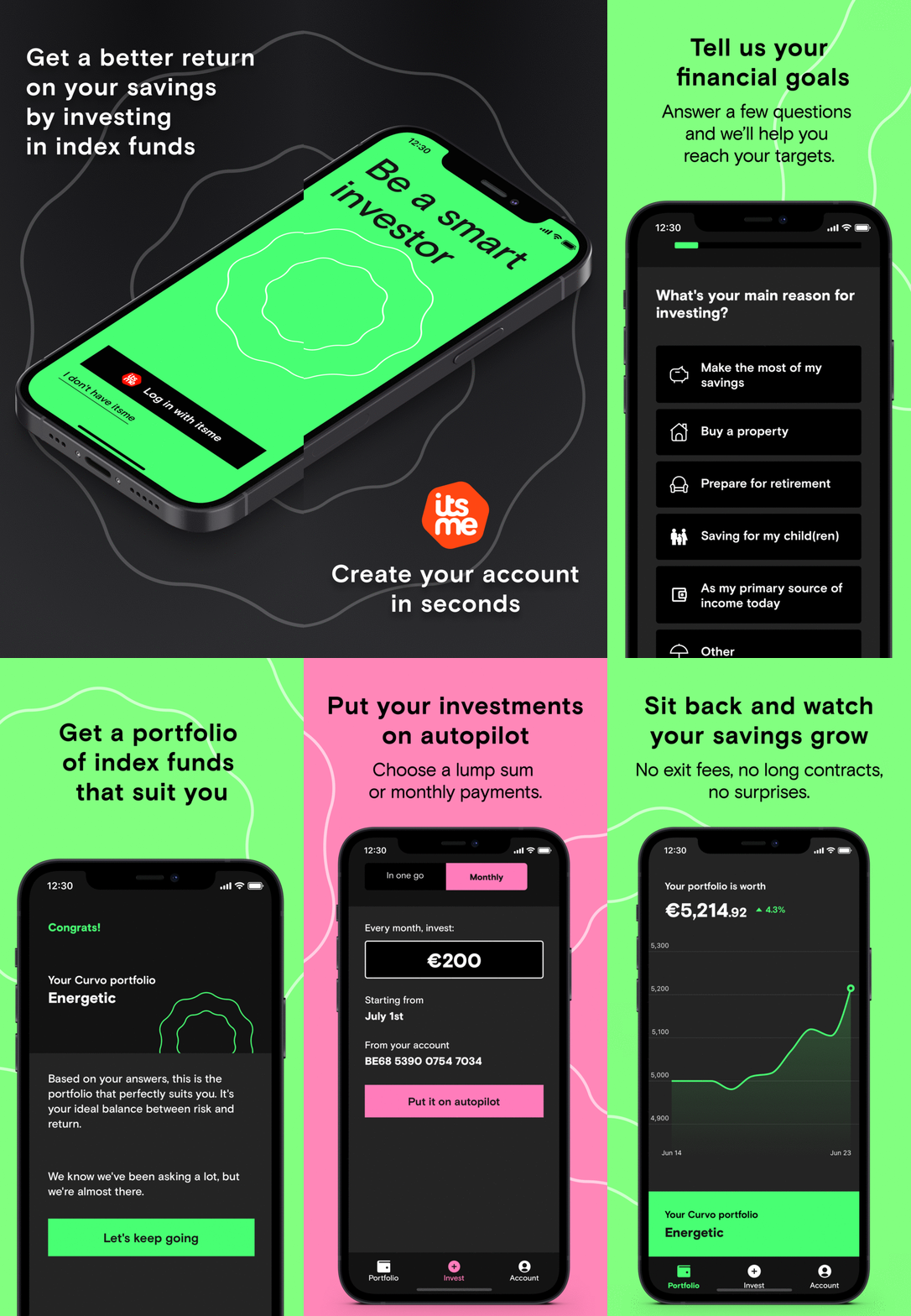
We charge a management fee of 0.6% to 1% a year depending on how much you invest. That is a cost you avoid by buying ETFs through a broker yourself.
Conclusion: should you invest in VGLA?
VGLA gives you almost the whole world stock market in one fund for 0.07% a year. If VWCE was your plan, this is the same idea done better, and there is no tax penalty for choosing it instead.
The Belgian transaction tax is what stops it being an easy answer for everyone. At 1.32% on every purchase and every sale, VGLA asks you to pay a lot up front for a small yearly saving. An ETF taxed at 0.12%, like IMIE, stays cheaper for well over a decade if you invest monthly.
The right ETF for you depends on how you invest, more than on which index is best. Large, rare purchases held for decades favour VGLA. Small monthly orders favour the lower transaction tax. And if you would rather not weigh transaction taxes against expense ratios at all, Curvo handles that for you and the transaction tax never enters the picture.