

How to reach financial freedom in Belgium
You've probably done the maths. At your current salary, even if you save aggressively, retirement feels decades away. And early retirement? That seems impossible.
The problem isn't your income. It's that most Belgians are never taught how wealth actually builds. Saving alone won't get you there, not with inflation eating away at your money every year.
The good news: thousands of Belgians are already on the path to financial freedom through simple, long-term investing. Here's how you can join them.
Understanding financial freedom
Financial freedom isn't only about retiring early. It's the moment when you no longer rely on a salary to cover your daily expenses. Your investments start generating enough income to support the life you want. Work becomes a choice rather than an obligation.
In Belgium, the concept of FIRE (Financial Independence, Retire Early) has grown popular because it gives people structure and a measurable target. But FIRE isn't about stopping work forever, it's about regaining ownership over your time. That is exactly how one member puts it: Ben's deadline is 50, and what comes after is work that pays less and means more.
There are many versions of FIRE:
- Lean FIRE: reaching independence with a modest lifestyle
- Fat FIRE: maintaining a more comfortable or luxurious lifestyle
- Coast FIRE: saving heavily early so your investments can grow without further contributions
- Barista FIRE: working part-time to bridge the gap
Belgian FIRE enthusiasts have proven it's possible with careful planning and long-term investing but the first step is understanding your numbers. However, there's a lot more to reaching financial freedom than following the FIRE movement. Let's dig into the different steps.
Step 1: Calculate your financial freedom number
Your financial freedom number is the total amount you need invested to cover all your yearly expenses indefinitely. The common guideline is:
Annual expenses × 25 = your financial freedom number
This is based on the widely used 4% rule that suggests you can withdraw 4% from a diversified investment portfolio each year without running out of money over a 30-year+ period.
- If you currently spend €30,000 per year: €30,000 × 25 = €750,000
- If you want €40,000 per year: €40,000 × 25 = €1,000,000
This number might look intimidating at first. But when you're investing consistently and giving your money decades to grow through compounding, it becomes surprisingly reachable.
It's important to note that the 4% rule was the result of a study over a specific time period (30-year periods between 1926 and 1992) in a specific country (the US). It may be too optimistic for the decades to come and for a Belgian setting. So it's wise to aim for a more conservative "3% rule" or even 2.5%. This means you'll take longer to reach your goal, but you're less likely to run out of savings while you're enjoying your early retirement.
Step 2: Optimise your savings rate
Your savings rate, the percentage of your income you save, has a direct impact on how quickly you can reach financial freedom. The financial freedom movement highlights how increasing your savings rate:
- Lowers your future required spending
- Helps you accumulate wealth faster
- Makes your financial freedom number easier to reach
High taxes and rising cost of living mean Belgium may not be the best place to reach financial freedom. But even small improvements can create massive results when invested consistently:
- Audit your subscriptions and recurring services
- Downshift lifestyle inflation (the biggest wealth-killer)
- Lower transport costs by cycling or using shared mobility
- Live in a cheaper area, for instance in the countryside rather than in downtown Brussels or Antwerp.
- Build an emergency fund so you don't derail investments
Remember: you don't need a 50% savings rate to make progress, what matters is building momentum and consistency.
Step 3: Put your money to work
Saving money alone won't get most Belgians to financial freedom. With inflation around 2% to 3% per year historically, money sitting in a savings account loses value over time. To reach financial independence, your money needs to grow. The most effective, evidence-backed way is through long-term, diversified index investing.
See what Belgian inflation alone did to a lump sum since 1995:
Why index investing works for Belgians
We believe index investing is the best way for most to grow their long-term wealth because decades of academic research show:
- Low costs matter more than almost anything else
- Diversification reduces risk and makes returns more stable
- Time in the market beats trying to time the market
- Globally diversified portfolios historically generate strong returns
Index funds and ETFs allow you to own thousands of companies across the world, in a single, low-cost package. They remove complexity and eliminate the need to pick stocks.
Take for instance the MSCI World index. It's a widely used index composed of 1,600+ stocks from developed markets (US, UK, Germany, Japan, etc), and you can invest in it through an ETF like IWDA. Over the last 48 years, it has returned an average 10.5% per year. That means that a €10,000 investment in 1978 would have grown to more than €1,000,000 today.
Why not pick stocks yourself?
Most individual investors tend to underperform the market, and even professional fund managers rarely beat a simple index over the long term. On top of that, the high fees charged by actively managed funds quietly eat into your returns. When we first learned this, it became obvious why the Bogleheads philosophy, inspired by Vanguard founder John Bogle, fits so well with what we try to do at Curvo: keep things simple, keep costs low and focus on long-term growth.
Bogleheads principles
The Bogleheads movement promotes simple, evidence-based investing. Curvo's approach is built on many of these same ideas:
Live below your means
Your savings rate drives your financial future.
Save early and consistently
Investing small amounts over decades beats investing large amounts later.
Diversify globally
Avoid concentration in Belgian companies or the Eurozone only. The world's growth engine is global.
Don't try to beat the market
Time, not timing, is what builds wealth.
Minimise taxes
Belgium taxes dividends at 30%, capital gains at 10%, and ETF transactions between 0.12% and 1.32% (the TOB) depending on the ETF. The ETFs you choose determine the taxes you'll have to pay.
Keep it simple
A simple portfolio performs better than a complex one 99% of the time.
These principles are the backbone of a strategy that is accessible for anyone, especially beginners.
How much should you invest?
A rule of thumb inspired from the FIRE community is:
- Invest 15% of your income for a comfortable retirement
- Invest 25% to 40% to reach early retirement
- Invest 50%+ to reach financial freedom quickly
But investing efficiently is important. Even if you save a large percentage of your income, it's unlikely you'll reach your goal if you keep it all in a savings account.
Choose how you invest
Belgian investors generally have three paths:
Option 1: DIY investing through a broker
A broker is a service that lets you invest in ETFs by giving you access to the world's stock exchanges. Through one platform, you get access to thousands of ETFs and stocks that you can trade. This is great, but can also be very intimidating.
Pros:
- Full control
- Access to low-cost ETFs
- Cheapest if done correctly
Cons:
- Requires research and understanding of taxes
- You must rebalance manually
- Easy to make emotional mistakes
- Time-consuming
DIY is great for people who love investing. But many Belgians start with good intentions only to get stuck, confused, or overwhelmed. Check out our resource on the best brokers in Belgium if you do decide for the DIY route.
Option 2: Automated investing with Curvo
Curvo builds portfolios based on the Bogleheads principles, meaning globally diversified, low-cost, and focused on long-term growth.
Pros:
- No need to pick ETFs or rebalance
- No TOB on transactions
- No dividend tax (only accumulating funds)
- Invest monthly on autopilot
- Designed specifically for Belgian investors
- Transparent and aligned with long-term goals
Cons:
- Slightly higher cost than doing everything yourself
- Less control (which for many is actually a benefit)
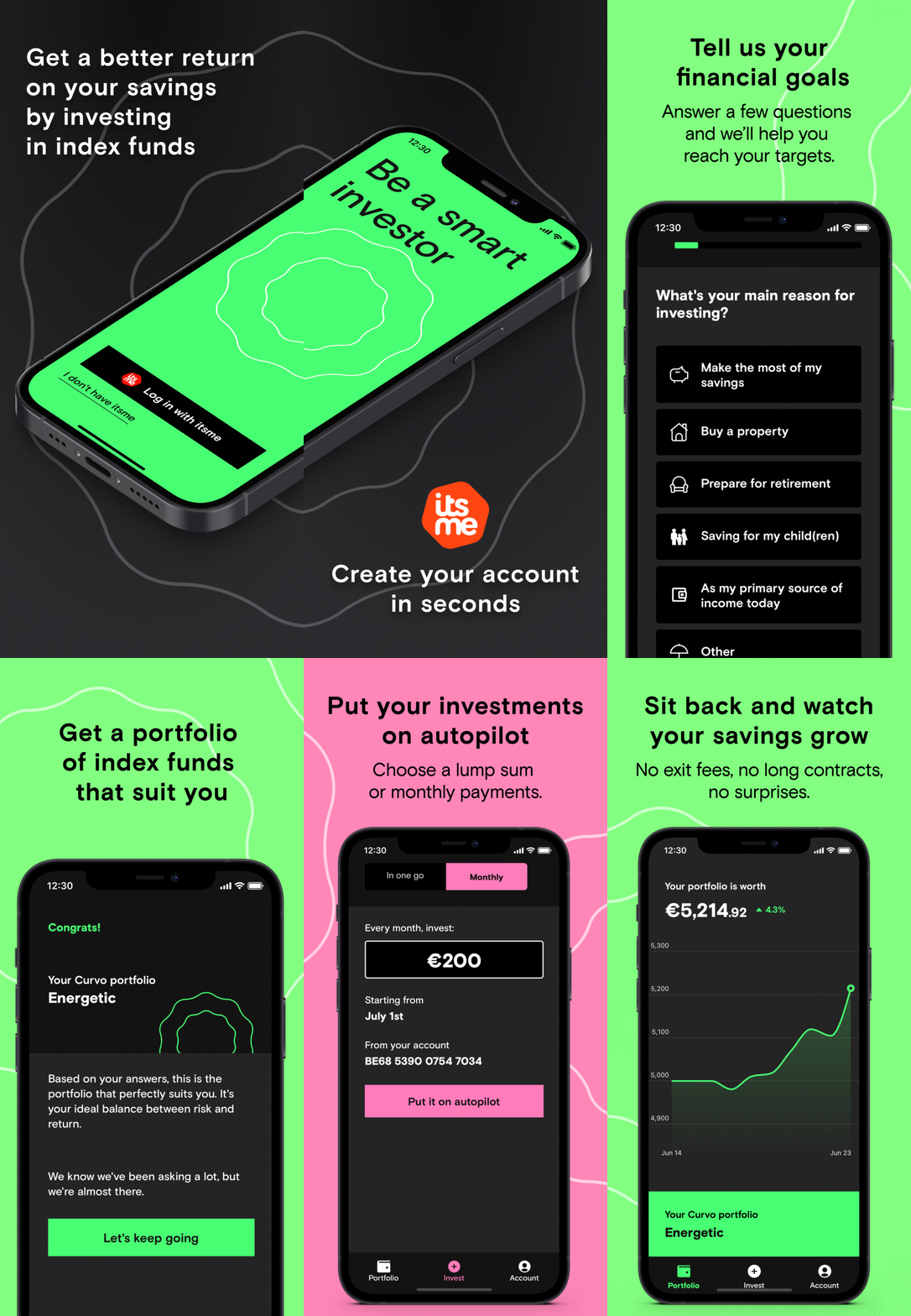
If you want a hands-off, optimised approach that's tailored to Belgium, this option aligns perfectly.
Option 3: Traditional Belgian bank
You still get human guidance and a sense of familiarity, but this usually comes with high fees that often reach 2% a year. Many of the products also underperform simple index funds and offer less transparency. For most people, the high costs make this approach less effective.
Stay the course: the hardest part of investing
Investing isn't difficult, sticking with it is. The real challenge shows up once you're in the markets. You'll face moments when everything seems to fall apart. Markets crash, headlines scream panic, and you start doubting whether now is the right time to invest at all. You might even feel tempted to chase whatever fad everyone is talking about, simply because it feels like you're missing out.
But history tells a different story. Markets have always recovered, even after the worst crashes. Investors who stay invested tend to fare much better than those who jump in and out based on fear. Over the long term, discipline matters far more than intelligence. You don't need to outsmart anyone, you just need to stick to your plan.
Your job is simple, even if it isn't always easy. Automate your contributions, stay consistent, and try your best to ignore the short-term noise. The less attention you give to daily market movements, the more likely you are to reach your goals.
Other ways to reach financial freedom in Belgium
Investing is the engine, but there are other levers you can pull.
Increasing your income can make a big difference to your long-term wealth. You might start by negotiating your salary, especially if you haven't had that conversation in a while. Sometimes switching companies or even fields can also lead to a meaningful jump in earnings. And if you feel comfortable taking on extra work, freelancing or running a small side business can bring in additional income without locking you into a new full-time job.
Cutting your biggest expenses is another powerful lever. For most Belgians, housing and transportation take up the largest share of the budget. Even small improvements in these areas can free up money that you can put towards your goals.
You can also explore ways to build passive income. Some people create digital products, others experiment with online businesses, and some consider rental property although that one requires caution because it comes with risks and responsibilities.
None of these steps are mandatory. The investing path still works even if you don't increase your income, cut expenses or build passive income streams. But if you do decide to work on one or several of them, you may speed up your progress.
Track your progress
Reaching financial freedom is a long journey. You won't always feel motivated, and your life circumstances will change.
Every year:
- Review your savings rate
- Recalculate your FIRE number
- Make an overview of your wealth and see how far you are on your journey
- Reflect on your goals
The path to financial independence isn't just about numbers, it's also about building a life that feels meaningful and sustainable.
The Belgian advantage of financial freedom
Many Belgians underestimate their financial potential because taxes feel high and salaries can seem limited. But Belgium actually offers several advantages that make it a great place for long-term investors. We benefit from strong social systems like healthcare, pensions and unemployment protection. These safety nets reduce the pressure to hold large amounts of cash.
Belgium also has a stable and diversified economy, and we have easy access to high-quality index funds that let you invest globally at low cost. In many regions, the cost of living is also relatively affordable compared with neighbouring countries. And one of the biggest perks is that Belgium has a low tax on capital gains compared to other countries (it used to have none before 2026).
Put all this together and you get an environment where disciplined long-term investors can thrive.
Conclusion
The journey to financial freedom starts with understanding your number, optimising your savings rate, and putting your money to work through long-term investing. You don't need to follow every FIRE strategy or hit extreme savings targets. What matters is making steady progress that fits your life.
Most Belgians have everything they need to build wealth: stable income, access to global markets, and favourable tax treatment on capital gains. The missing piece is often just getting started and staying consistent through the years ahead.
Whether you choose to manage everything yourself or prefer an automated approach that removes the guesswork, the important thing is to begin. Your future self will thank you for the small steps you take today.