


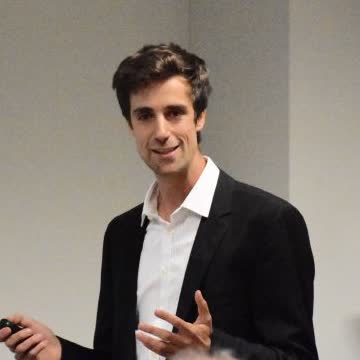
Harry studies glaciers and ice caps at the Vrije Universiteit Brussel: how they change as the climate warms. It's a field where the signal only shows up over long stretches of time. A single warm summer, or a single cold one, tells you almost nothing on its own.
It's also how he thinks about his money.
A researcher's eye for hidden costs
Before Curvo, Harry's money sat partly in a savings account and partly in a few funds through his bank, a mix of equities and bonds. He wasn't unhappy with the returns. What bothered him was what he couldn't see.
It's logical that there are certain costs, but they're not always made explicit, and that's something I wasn't a fan of. With funds there are also things you don't really see, like service costs, that's something I didn't pay much attention to at the time.
Curvo's flat, visible pricing appealed to the same instinct that makes him careful about data in his own research: if you can't see a number clearly, you can't trust it.
What I really liked about Curvo is that everything is very clear: no hidden or vague costs.
Comfortable with the short-term noise
Climate science deals constantly with short-term noise around a long-term trend: individual years swing around a signal that only becomes clear over decades. Harry applies the same lens to markets.
The world does what it does. Markets go up, markets go down. But the costs stay limited, you have a clear overview, and the app is simple to use.
In four and a half years, including periods when markets dropped, he's never withdrawn a euro or felt the pull to.
I've never felt the urge to pull money out at a bad time. That's really what I was looking for: not having to be very active, just knowing my money is being put to work.
He points to Curvo's backtested long-term performance data as part of what makes that possible, the same way he'd point to a long-run climate dataset rather than a single year's reading.
What I've seen in the backtests linked to Curvo is that, historically, take the 2008 crisis, for example, the market can drop in the short term, but it comes back. We don't know what the future holds, but since World War II there's been a tendency for it to keep growing over the long term, with serious dips along the way.
One decision, not a hundred small ones
Harry applied the same reasoning to a €10,000 lump sum. Rather than spreading it across several months to manage market-timing risk, he invested it in a single decision.
I did think about spreading it out because of market ups and downs, but in the end that was my way of investing that sum: putting it in at once, and just letting it ride from there.
It's a small thing, but it reflects the same principle behind his research: trust the long-term trend, and don't over-engineer a response to short-term variation.
Minimalist by design
For someone who spends his working life analysing data, Harry doesn't want to analyse his portfolio.
It's minimalist, but I think that's really its strength.
His advice to anyone starting out echoes the same idea: you don't need to become an expert to get this right.
A lot of people don't really know what investing, buying, selling, or the stock market even means. Curvo is a good tool for that, with honest and transparent pricing.
You might be wondering
Why does long-term thinking matter so much in investing?
Harry, who studies decades-long climate trends professionally, applies the same lens to markets: short-term swings are noise around a long-term signal. He points to Curvo's backtested data showing markets recovering from downturns like 2008 as evidence the long-term trend is what matters, not any single year.
Is it better to invest a lump sum at once or spread it out over time?
Harry considered spreading a €10,000 lump sum to manage market-timing risk, but ultimately invested it in one go, applying the same long-horizon reasoning he uses in his research: trust the trend rather than over-engineering a response to short-term variation.
How do you stay invested when the market drops?
Harry has never withdrawn a euro in four and a half years, including during downturns. He credits Curvo's backtested long-term data, showing recoveries after past crises, as the reason he doesn't feel the need to react to short-term drops.