


Cheapest broker in Belgium for ETFs (2026)
You want the cheapest broker in Belgium to invest in ETFs. Fair enough. Fees matter, especially when you're investing every month for decades.
But "cheapest" isn't just a single number. What you actually pay depends on how you invest (lump sum or monthly contributions), what you buy, and the Belgian cost stack sitting on top of every trade: TOB, currency spreads, custody fees. Get those wrong and the "cheapest" broker on paper quietly becomes the most expensive one in practice.
And then there are the costs that don't show up on any fee schedule at all: the hours spent learning about passive investing, the monthly chore of placing orders, the spreadsheet you maintain to track your portfolio and the discipline it takes to stay the course when markets drop.
This article breaks down the real all-in cost of investing with the main brokers available to Belgian investors, both the financial costs and the ones you pay with your time and effort. If you want a broader comparison covering interface, product range and support, read our best broker in Belgium for ETFs guide instead. This one is about what it actually costs you.
Cheapest broker for a €300/month ETF investor
Let's imagine this scenario: €300 invested every month into the IWDA ETF (iShares Core MSCI World, Irish-domiciled, accumulating, EUR-traded on Euronext Amsterdam). The total invested after a year is €3,600. Let's compare the fees:
| eToro | €0.00 | €4.32 | ❌ No |
|---|---|---|---|
| MeDirect | €0.00 | €4.32 | ✅ Yes |
| Trading 212 | €0.00 | €4.32 | ❌ No |
| DEGIRO.fr | €1.00 | €16.32 | ✅ Yes |
| DEGIRO.nl | €1.00 | €16.32 | ✅ Yes |
| Trade Republic | €1.00 | €16.32 | ✅ Yes |
| ING Self Invest | €1.05 | €16.92 | ✅ Yes |
| MEXEM | €1.79 | €25.80 | ✅ Yes |
| Re=Bel | €2.00 | €28.32 | ✅ Yes |
| Saxo Bank | €2.00 | €28.32 | ✅ Yes |
| Easybroker | €3.00 | €40.32 | ✅ Yes |
| Interactive Brokers | €3.00 | €40.32 | ❌ No |
| Bolero | €5.00 | €64.32 | ✅ Yes |
| Keytrade Bank | €5.95 | €75.72 | ✅ Yes |
| LYNX | €6.00 | €76.32 | ✅ Yes |
MeDirect wins as it offers "commission-free" ETF investing (we're dismissing eToro as they don't handle the transaction tax). Trade Republic and DEGIRO come second. Re=Bel, Saxo and MEXEM form a tight middle cluster around €28 per year. Bolero and Keytrade are more expensive at this scale, but all auto-handle Belgian taxes for you.
However, the cheapest broker on a year-1 spreadsheet isn't necessarily the cheapest after administration and the behaviours each broker nudges you into.
The fees of a broker
Let's take a closer look at all the fees you may pay through a broker in buying your ETFs.
Transaction fees
The headline number that ranges from €1 for commission-free brokers to around €6 per order at a Belgian bank like Keytrade. One important nuance: a broker with a €1 fee that nudges you into 12 trades a year costs €12 in commissions. A broker with a €5 fee that lets you batch once a quarter costs €20. Frequency matters as much as the fee itself.
Transaction tax: 0.12% or 1.32%
Belgium charges a stock exchange transaction tax ("taxe sur les opérations de bourse" or "beurstaks") on every ETF purchase and sale. This isn't directly a broker cost but it's something to keep in mind. The rate depends on the fund's domicile and distribution of dividends:
- 0.12% for distributing ETFs
- 1.32% for accumulating ETFs, unless they're not registered in Belgium
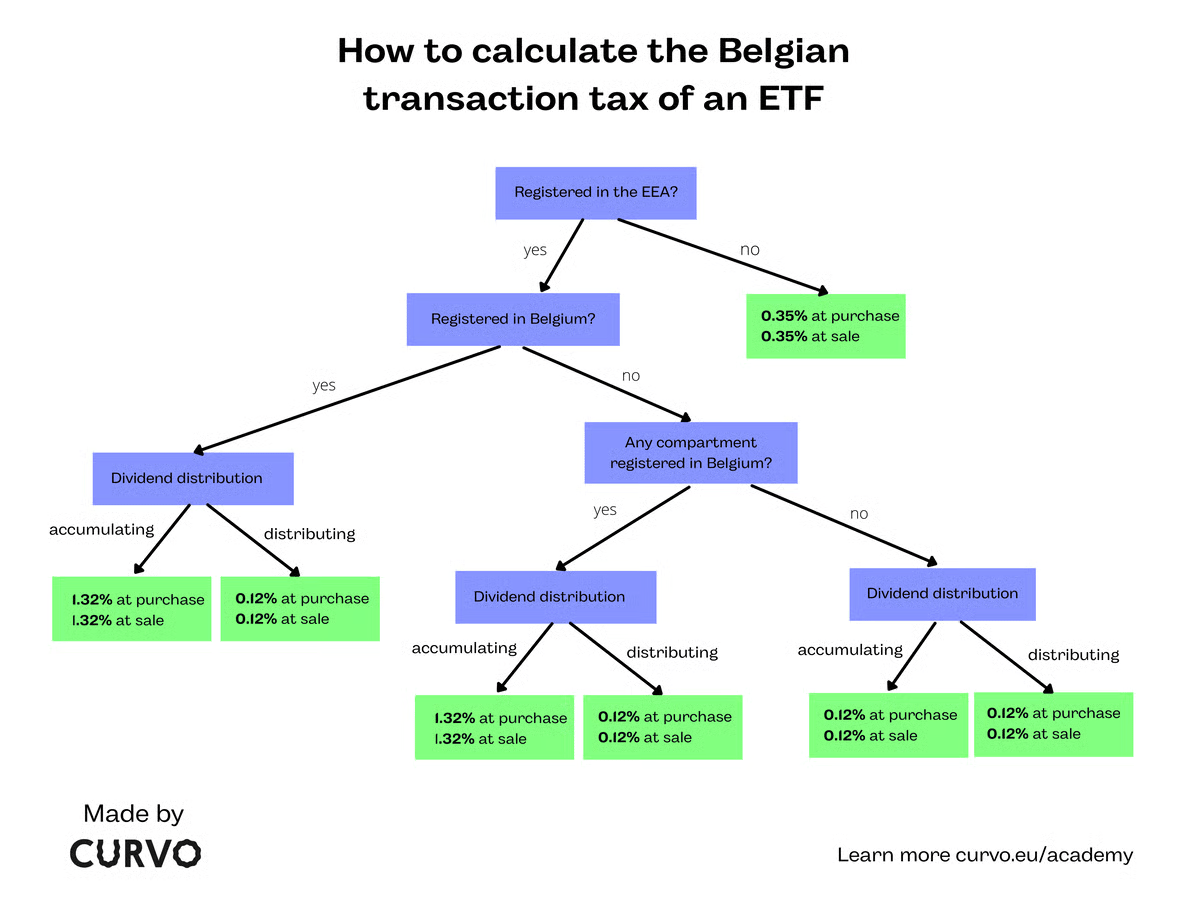
On a €10,000 purchase, that is a €12 tax versus a €132 tax. So the choice of ETF can dwarf the choice of broker.
Belgian brokers and some foreign brokers auto-calculate and pay the TOB for you, like Bolero, Saxo, or DEGIRO. Trade Republic is a significant exception: you file it yourself monthly via MyMinFin. Miss the deadline and you may have to pay a fine. That admin burden is a real cost for you as an investor.
Curvo funds are exempt from the TOB entirely thanks to its fund structure, so there's nothing to file and nothing to pay.
Currency conversion
Buy a USD-listed ETF like VOO (it's a popular S&P 500 ETF) and your broker converts EUR to USD on every trade. Spreads vary widely: Interactive Brokers charges around 0.002% (negligible), Bolero charges 1.5% and Keytrade around 1%. On a €10,000 purchase, that is €0 versus €150 on a single trade.
The simple fix is to stick to EUR-traded, Irish-domiciled ETFs like IWDA, VWCE, EUNL, SPYI. Then currency cost drops to zero on any broker.
Custody and inactivity fees
Good news: none of the main brokers we've listed charge ongoing custody fees on ETF positions. DEGIRO charges €2.50 per year per foreign exchange you use (waived for your home exchange). Keytrade has a dormant-account fee if your account goes inactive. Bolero, Trade Republic, MEXEM, Re=Bel and Saxo charge nothing.
Withdrawal and deposit fees
They're free for SEPA transfers. Watch for MEXEM's one-free-withdrawal-per-month rule and Trade Republic's instant withdrawal fees on some tiers.
Reynders tax and capital gains tax
A 30% capital gains tax applies to the bond component of any ETF holding more than 10% bonds, payable on sale. This is the Reynders tax. Belgium also levies a 10% capital gains tax on profits from selling ETFs, with the first €10,000 per year exempt. Neither is a broker fee, but your broker determines how painful both are to deal with. Belgian brokers handle the calculation and withholding automatically. With a self-reporting broker like Trade Republic, both are your responsibility and neither calculation is straightforward.
Capital gains tax calculator
Calculating your capital gains tax is tricky. That's why we built a tool that does it for you. It analyses your broker transactions and tells you exactly how much tax you owe, so you know what to declare.
Learn more in our guide to the best broker in Belgium for ETFs.
The real cost of doing it yourself
The comparison above focuses on fees. But fees are only part of the equation. Using a broker comes with costs that don't show up on any fee schedule.
The cost in time
Before you buy your first ETF, you need to learn about passive investing: accumulating vs distributing funds, fund domicile, tracking difference, TER... It takes weeks of research before you feel confident enough to get started. And that's just the beginning.
Once you understand the basics, you have to build your own portfolio. Which ETFs? What allocation between regions? How much in bonds? How much in emerging markets? There's no single right answer, which makes it harder, not easier. Sam's five-year comparison shows what that work bought him: the returns nearly tied.
Then there's the monthly routine. Every month you log in, calculate how many shares to buy, place your orders. It doesn't take long. But after a while, it becomes one of those tasks you dread.
And then there are taxes. TOB, Reynders tax, declaring foreign accounts, capital gains tax... Belgian tax rules for ETF investors are complicated. They also change regularly, so you have to stay up to date.
Costly for monthly contributions
Investing a fixed amount every month is the strategy most passive investors follow. But brokers charge per transaction, so frequent small investments eat into your returns. On top of that, you can mostly only buy whole shares. If IWDA costs €95 and you invest €300, you buy 3 shares for €285 and the remaining €15 sits as cash on your account. Over time, that uninvested cash adds up.
Rebalancing
Your portfolio drifts over time as some funds outperform others. At some point you need to rebalance: sell what's overweight, buy what's underweight. But when? Quarterly? Yearly? After a market crash? Each rebalancing event means more transactions, more fees and more tax events to track.
Keeping track
Most brokers don't give you a clear overview of your total return, asset allocation or progress towards your goals. Many investors end up maintaining a spreadsheet to stay on top of things. It works, but it's yet another thing to manage.
Staying disciplined
When markets drop 20%, the temptation to sell is real. Without a system that encourages long-term thinking, many investors make emotional decisions that hurt their returns.
It doesn't help that brokers want you to trade. That's how they make money. You'll get notifications about "opportunities", trending stocks, new products. Resisting the noise takes real discipline.
How Curvo takes care of all of this
We built Curvo to solve these problems. When you sign up, you answer a short questionnaire and we match you with a portfolio built for the long term. No need to research ETFs or figure out allocations.
Your contributions are invested automatically through fractional shares, so there's no cash left sitting on the side. Rebalancing is handled for you. Taxes are taken care of: the funds in the portfolios aren't even liable for TOB, saving you between 0.12% and 1.32% on every transaction. And we give you the exact numbers you need for your yearly tax declaration.
The app is designed to keep you invested for the long term. No trading notifications, no "hot stock" alerts. Just a clear view of your portfolio and its progress towards your goals.
The trade-off is that you pay an annual fee starting from 0.6% and you give up control over which funds are in your portfolio. For a €300/month investor, that works out to around €14 in the first year. Curvo is built for people who want to invest monthly on autopilot, not for people who want to hand-pick their holdings.
Conclusion
If pure cost is your only concern, MeDirect wins on fees for a €300/month ETF investor. Trade Republic and DEGIRO are close behind, at around €16 and €19 per year respectively. Trade Republic is slightly cheaper but requires you to file TOB yourself. DEGIRO handles it for you. MEXEM, Re=Bel and Saxo sit in the middle ground, while Bolero and Keytrade are hard to justify on cost alone.
But as we showed in this article, broker fees are only one part of the cost. You also pay with your time: learning about passive investing, building your own portfolio, placing orders every month, figuring out Belgian taxes, rebalancing, tracking everything in a spreadsheet. And you pay with your mental energy: resisting the urge to sell during a crash, ignoring the trading notifications your broker sends you.
If you want to skip all of that, Curvo handles it for you. You get a diversified portfolio matched to your goals, automatic investing through fractional shares, no TOB, and the exact numbers for your tax declaration. The annual fee starts from 0.6%. For a €300/month investor, that works out to around €14 in the first year. Whether the time and effort you save is worth the fee is up to you.