


Staying invested for life: Yoran on his second book
Investing your savings has never been easier. A portfolio of ETFs that owns a slice of the whole world economy, set up in ten minutes on a Sunday afternoon, using Curvo or a broker. But three years after De hangmatbelegger persuaded a generation of Belgians to start, its authors found that starting was the easy half. Staying invested through two decades of moving house, having children and reading the news is where the money is won or lost. That gap is why Hangmatbelegger voor het leven exists.
It is the second book by Curvo co-founder Yoran Brondsema and Tim Nijsmans, out since August 2026. We asked Yoran six questions about it. This is the second time we have interviewed our own co-founder.
Your first book already teaches you everything you need to know to start investing in ETFs. Why write a second one?
I finished De hangmatbelegger telling myself I would never write another one. But gradually it became clear that the first book had become a hit. Van Dale made "hangmatbeleggen" its 2024 Word of the Year in Flanders and gave the word a permanent place in the dictionary. In Flanders, hangmatbeleggen has become more or less a synonym for passive investing. Private banks wrote internal briefings teaching their advisers how to handle critical questions from clients who had read us. Nobody needed convincing any more that passive investing beats picking funds. What nobody had written down was the part that comes after.
On top of that, Tim and I both received a lot of emails and DMs from investors. They came from people who had read the first book and started investing. They asked whether they were still doing it right, or doubted whether they had made a good choice, or were about to retire and wondered how to adjust their investments for it.
The common thread was this: starting is one thing, keeping going is much harder. And keeping going matters so much, because the real returns on the stock market come over the long term.
By then my bad memories of writing the first book had faded, and mostly the good ones were left. So Tim and I decided to write this second book.
What do readers actually get stuck on?
Ourselves, really. Or more precisely, our behavioural biases. These are the ways we behave irrationally and, at crucial moments, let our emotions lead us too much. That leads to bad investment decisions.
Investors start to doubt themselves as the market goes up and down. A new investor's portfolio is down 8% after six months, and they wonder whether they made the wrong choice. During a dip they ask whether to step out until the war is over. And when the market is doing well, they want to wait for a dip before putting more in.
Two habits of mind do most of the damage. The first is outcome bias, which means judging a decision by how it turned out. One reader wrote that his returns were downright disappointing, that he was not even beating the savings rate, and that he would stop if it did not change soon. He sold shortly afterwards. His timing was unlucky. His decision to start was not wrong.
Then there is recency bias. We give too much weight to what is happening now, and forget the lessons of history too quickly. Whatever did well lately starts to look like the future. In 2023 readers asked why our model portfolios were not 100% S&P 500. In 2026 they complained that world ETFs are investing too much in the US.
Together they produce the behaviour gap, which is the return that we lose due to our behavioural biases. Morningstar's Mind the Gap 2025 puts it at 1.2% a year for the average dollar in US funds and ETFs over the ten years to December 2024. The breakdown matters here too. Sector funds lost 1.5% a year to it. All-in-one funds, the broad ones that handle the asset allocation for you, lost just 0.1%. The simpler and broader the fund, the more of its return its investors actually keep.
So where should someone start?
With a portfolio spread across the whole world economy, and only money you will not need for years. That is boring, but boring is exactly the point. Two things matter for someone starting out.
The first is the order you do things in. Build an emergency fund, then set aside the goals that are only a few years away, then invest what is left for the long term. The first phase of adult life is the expensive one: a flat, a wedding, children, a renovation that costs more than the quote. The worst thing that can happen to a long-term investor is being forced to sell while the market is down.
The second is to own the whole world instead of the part you recognise. A BEL 20 tracker feels safer to a Belgian because you know the names, but it holds less than 0.3% of the world's listed companies and skips the sectors Belgium barely has, such as software and luxury goods. A portfolio that invests across the whole world, such as the Curvo Growth portfolio, owns all of it. After that, the only real decision left is how much of the portfolio sits in shares and how much in bonds, and that follows from when you need the money and how large a drop you can live through. It is a question about you, not about the market.
Working out how much of your portfolio belongs in shares and how much in bonds is where most people get stuck. It depends on when you need the money and how large a drop you can sit through, and neither of those is something a fund fact sheet can tell you.
When you sign up to Curvo we ask a few questions about your goals, your horizon and your appetite for risk, and match you with one of our portfolios. If your horizon is short or your tolerance is low, that portfolio holds bonds.
How do you get children involved in your investments?
Investing in a child's own name is difficult in Belgium. Few platforms offer it. Parents get steered towards defensive or expensive bank and insurance products, where 2% a year in fees quietly eats a large share of eighteen years of growth. A big withdrawal from a minor's account can need sign-off from the justice of the peace, the local judge who guards a child's assets. And on the eighteenth birthday your child gets full access, whether or not that is the right year for it.
So Tim and I both invest on our own name instead, with a separate portfolio per child. Next to my own I keep one for my daughter and one for my nephew. It costs less, and we decide when the money is handed over. Both routes have real trade-offs.
For a young adult, a match works better than a lecture. When they get their first pay cheque, offer to put in whatever they put in. It solves the hardest problem, which is starting.
Investing on your own name is simpler and cheaper than opening an account in your child's name. What you lose is the overview. With two children, a godchild, and grandparents chipping in, it stops being obvious whose money is whose.
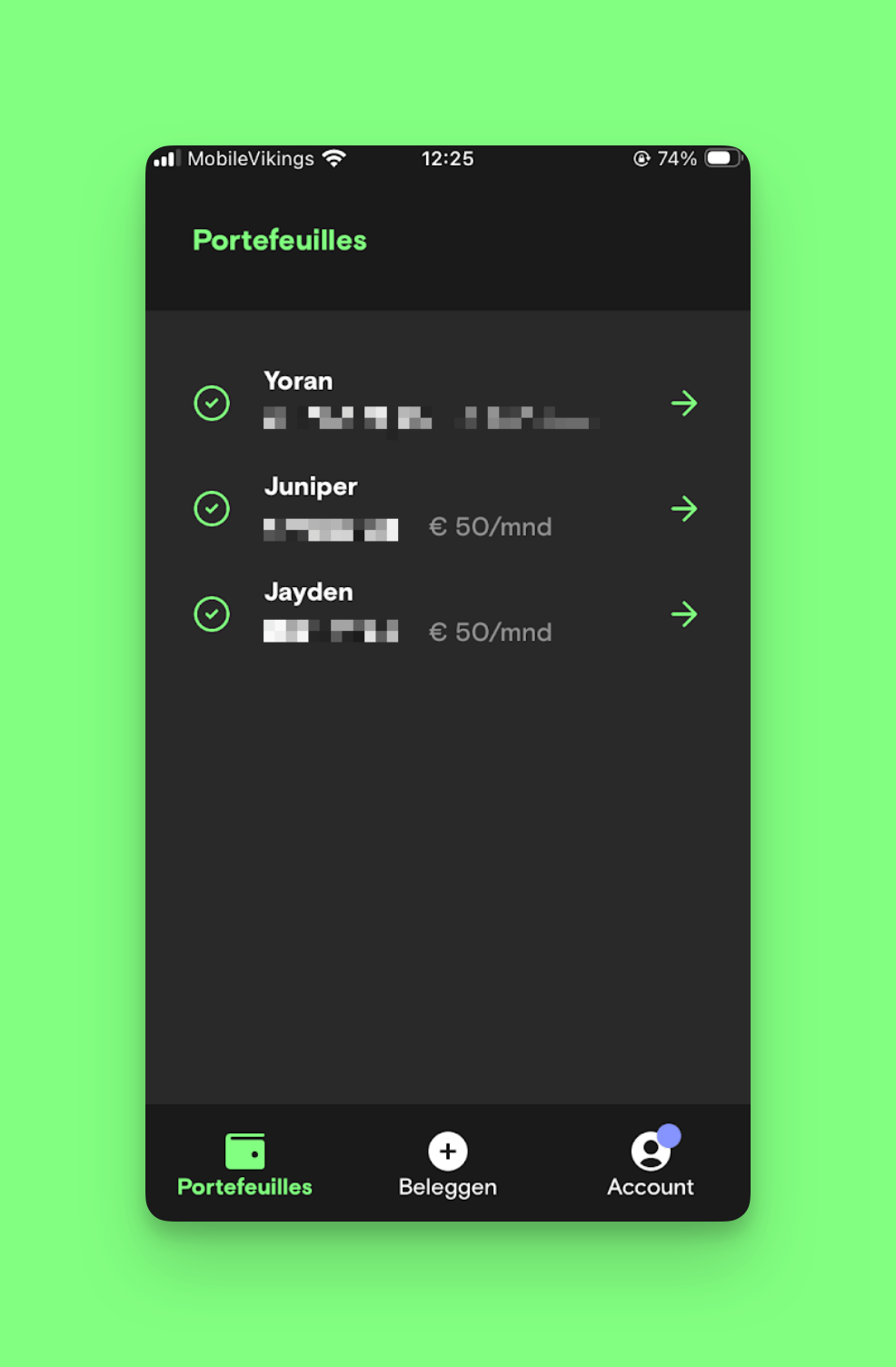
With Curvo you can open a separate portfolio for each child inside your own account, each with its own monthly deposit. The money stays legally yours, so you decide when it is handed over, but you can always see what belongs to whom. It is how Yoran does it for his daughter and his nephew.
And near the end: retirement, and passing it on?
The years just before and just after you stop working are the dangerous ones. The book calls that window the fragile decade. A crash at 67, with a full portfolio and withdrawals just starting, does lasting damage, because you are selling into it. The same crash at 85, with the state pension covering the basics, usually does not. The caution belongs around the retirement date, not spread evenly across the rest of your life.
Spending you can see coming needs its own money. If a motorhome and a tour of Europe are the plan for your first year of retirement, that money should be somewhere safe years before you stop working, not in equity ETFs you have to sell into whatever the market is doing that week. Bonds pay less and pay more predictably. That is the trade you are making.
The old rule of thumb says to hold 100 minus your age in shares, so 35% at 65. That rule comes from a time when people died younger and bonds paid more. Somebody who stops working at 65 today may live another thirty years, and a portfolio that defensive will not keep up with inflation over a stretch like that. So think in pots instead of in one number. Split the money by what each part is for: the basics, the first years of extra spending, the pot you are still growing for the long term, and the part your children will probably inherit. That last pot has their horizon, which can easily be thirty or forty years. For that money, your age is a bad guide.
The last piece is the one people skip. In most households one partner is the CFO. They know the logins, the accounts, and why each holding is there. That works until it does not. A simple hangmatbeleggen portfolio is easy to explain and easy for somebody else to keep going. What you want to avoid is your family selling everything in a hurry because nobody knows what it was for.
Your partner does not need to become interested in ETFs. They need to be able to see what exists and why, without asking you for a password.
Curvo has a viewer code for that. You share your portfolio read-only, so your partner can follow it without being able to change anything or move money out. Here is how to share your portfolio.
Who is Hangmatbelegger voor het leven for?
Any investor who has ever had doubts about their investments, or felt at times that their emotions were taking over, will get something out of the book. It shows the ways our brain plays tricks on us when we invest, and teaches you to deal better with changes in the market and in your life.
The sequel does not assume having read De hangmatbelegger. It assumes a reader with a portfolio and a life happening around it: a partner, a mortgage, children, a career that changes, a retirement date somewhere ahead. If you have not started yet, one of these books will get you going, and the interview we did about the first one covers that half of the story.
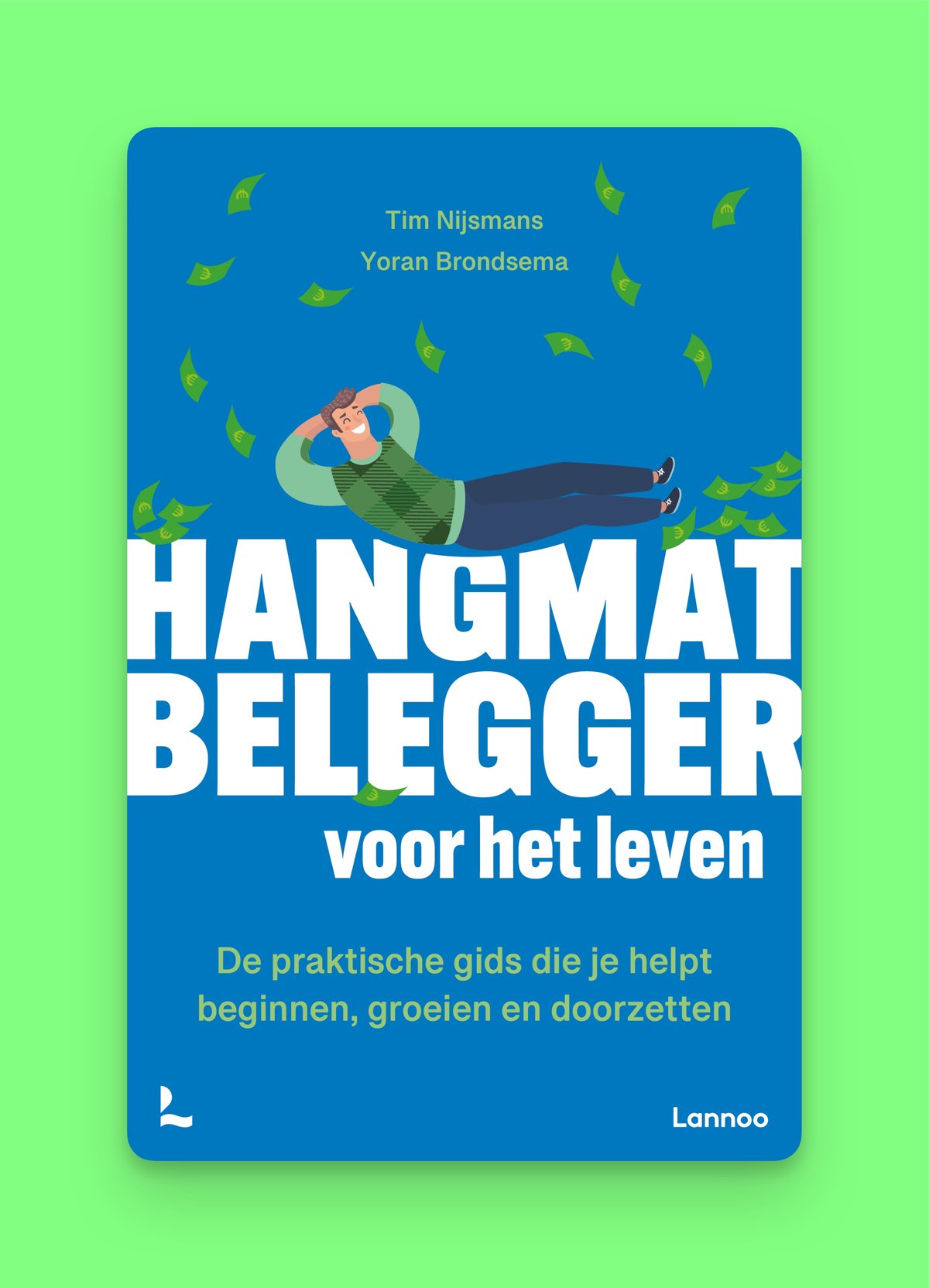
I wrote Hangmatbelegger voor het leven with Tim Nijsmans. Lannoo published it in August 2026. Het Laatste Nieuws covered it around five moments in a life when a passive investor has to act, and Robin Boone went through it part by part on his Fintastisch podcast. You can order it at dehangmatbelegger.be.
Staying invested is the decision that pays
Choosing the portfolio is a decision you make once. Keeping it is a decision you make again every year for thirty years, through a crash, a renovation, a baby and a retirement date. That is what Hangmatbelegger voor het leven is about.
The numbers say the same thing. Investors in broad all-in-one funds gave up 0.1% a year to their own timing, while investors in sector funds gave up 1.5%. A portfolio you barely think about is one you are still holding in year twelve, and that is where the missing 1.4% comes from.
So pick something boring enough that you will still hold it when the news is bad, and make the monthly deposit a thing you never have to decide on again. With Curvo that takes a few minutes to set up. The rest of it, thirty years' worth, is in the book.